
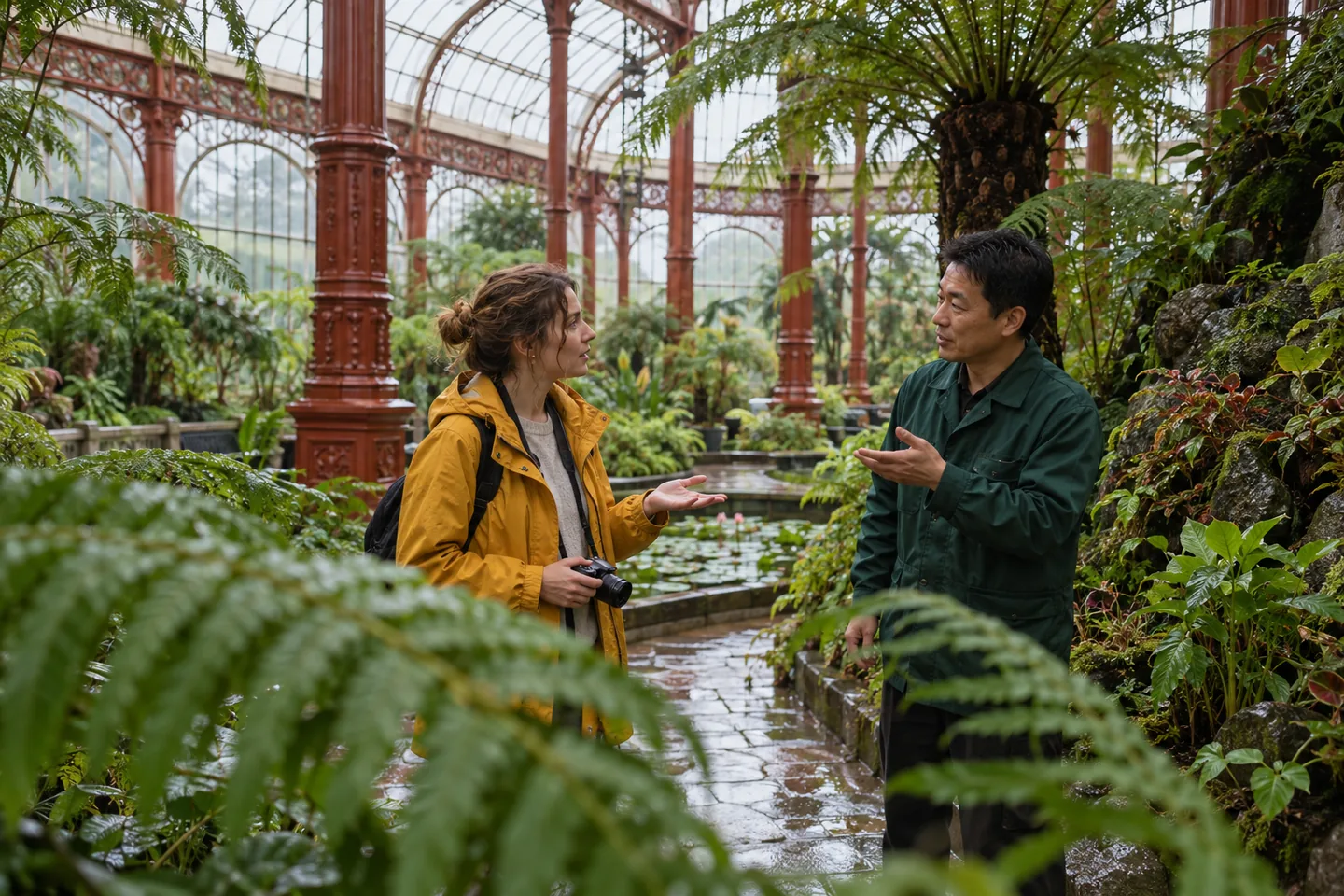
Asking permission in Japanese is useful precisely when you could do something but should check first. You are holding a camera, a window is closed, or someone else’s pen is within reach. Knowing the verb does not yet tell you how to pause the action and leave the decision with another person. A short question with 〜てもいいですか gives you a manageable starting point.
This guide builds one complete exchange: decide whose action is involved, form a clear permission question, listen for the answer, and act only within what was agreed. You can practise with paper cards, a checked dialogue and a partner. The goal is not to collect increasingly elaborate polite endings. It is to ask one ordinary question accurately and understand enough of the response to continue appropriately.
Asking permission in Japanese starts with the actor
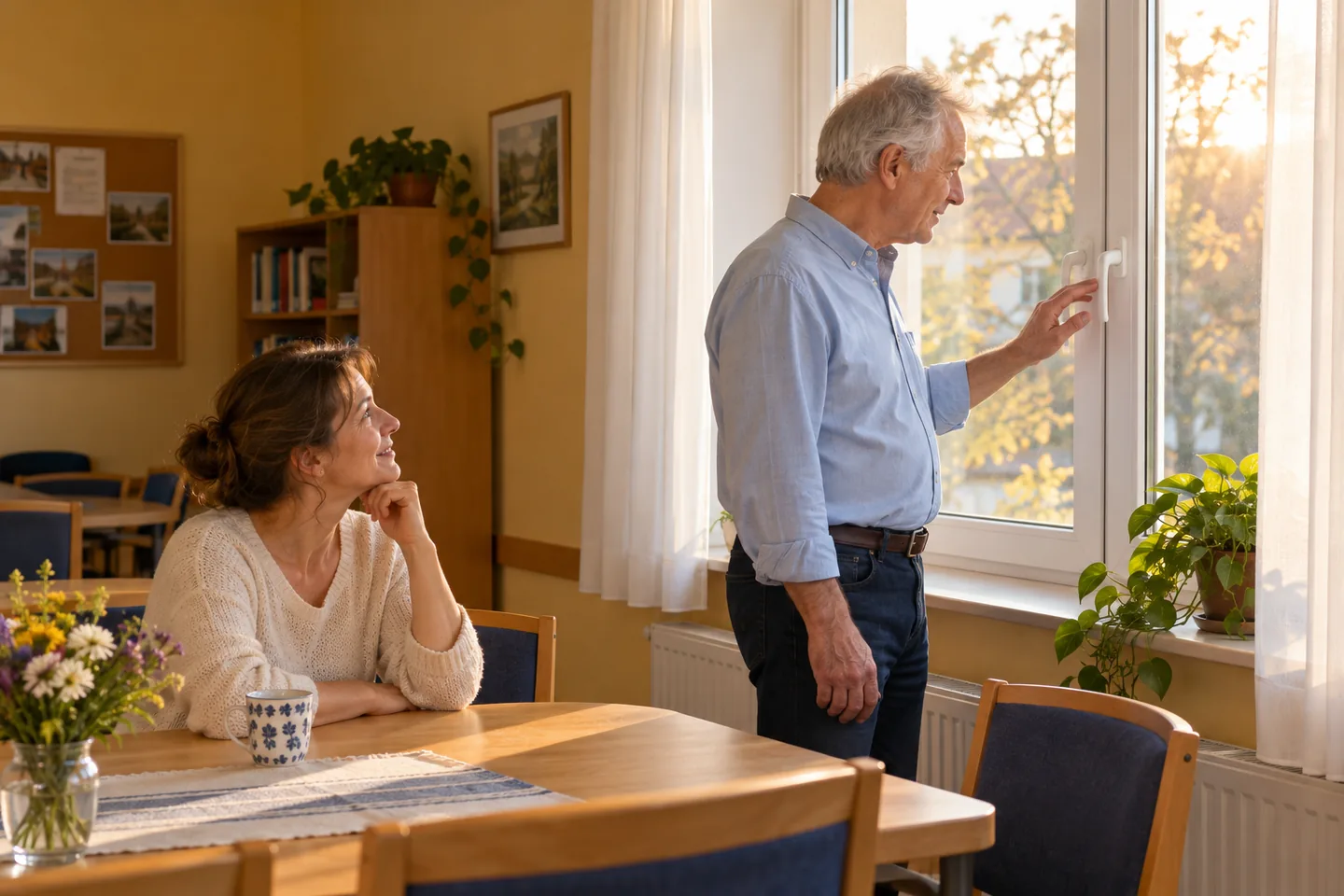
Picture a shared study room. You would like to open the window yourself. The other person is working beside it, so you ask before touching the handle. Your intended action is opening; the other person’s role is deciding whether that is acceptable. Write those two roles above your first practice sentence. This small preparation prevents a common mistake: learning a polite phrase without knowing who is supposed to do the action.
Compare that scene with wanting the other person to open the window for you. The physical result is similar, but the conversational job changes. A permission question concerns whether your action is acceptable; a request asks someone else to act. For today’s practice, keep these scenes separate. Draw a simple arrow toward the person who would move, photograph or borrow, then choose the sentence that matches that actor.
Make three scene cards before adding Japanese: taking a photograph in a public facility, using a shared pen, and opening a window near another person. On each card note the action, the object or place, and the person you would ask. Avoid vague cards saying only “Can I?” Without an identifiable action, you cannot check whether your sentence communicates the same situation to a listener.

Build the question from a checked te-form
The basic pattern is a verb in its te-form followed by もいいですか. For opening a window, 窓を開けてもいいですか。means “May I open the window?” Its kana reading is まどをあけてもいいですか. Keep the full sentence beside the scene, rather than memorising the ending in isolation. The Tokyo University of Foreign Studies grammar explanation confirms this construction for asking permission and distinguishes it from the statement that grants permission.
Check the verb before practising at speed. 開ける, あける, becomes 開けて; 使う, つかう, becomes 使って; 撮る, とる, becomes 撮って. For these examples the question continues with もいいですか. Other verbs can have a te-form ending in で, so do not attach a printed ても sequence mechanically to every dictionary form. Keep your first set small enough that you can verify each complete form.
Try a written reconstruction. Cover the model, look at the window scene and write the question once. Uncover it and compare the object marker を, the verb and the ending separately. If you wrote 開けるもいいですか, repair the missing te-form before adding another example. A short corrected sentence is more useful here than a long conjugation chart you cannot yet apply to an actual question.
Keep the action and location explicit
For a photograph, practise ここで写真を撮ってもいいですか。The reading is ここでしゃしんをとってもいいですか, meaning “May I take photos here?” The で marks the location of the activity in this sentence. Keep ここで while you learn the whole exchange: permission to take a photograph in one area need not tell you anything about another room or a different situation.
For the pen card, use このペンを使ってもいいですか。Read it このペンをつかってもいいですか: “May I use this pen?” Pointing can help establish which pen you mean during a role play, but the Japanese sentence should still be checked. A recognisable object makes feedback concrete. Your partner can tell you whether they understood the intended pen, rather than merely recognising the familiar ending of a question.
Change one detail per round. Move from the window to the pen while retaining the same permission pattern; then return to the original scene without looking at the model. If the verb disappears when the picture changes, vocabulary retrieval needs attention. If you say the right action but use the dictionary form, the repair concerns conjugation. Record those as different problems so tomorrow’s review targets the actual difficulty.
Practise the answer before you practise more questions
A useful beginner exchange has an answer and a consequence. Start with an unambiguous practice response: はい、どうぞ。, “Yes, go ahead.” After hearing it, say ありがとうございます。, “Thank you,” and describe what happens next in your own language. You are checking comprehension of the exchange, not trying to demonstrate every Japanese form you know. Let your partner vary the answer once this simple sequence feels stable.
Next practise a refusal supported by an explanation. The TUFS examples show that someone may decline by stating their circumstances, such as currently using the requested object. In your exercise, the pen owner can point to their unfinished work and explain that they need it. The task is to stop, recognise that borrowing is unavailable now, and choose another pen. Do not treat hearing a familiar polite word as permission.
Keep strong prohibitions out of your default reply script. You may encounter だめです or いけません, but their force and the speaker’s relationship to the decision matter. For a learner exercise, understanding that permission was refused is enough. You do not need to imitate an authoritative refusal to practise accepting one. Ask a teacher to check the response wording if you want to practise the person granting or withholding permission.
Listen for limits inside an otherwise positive reply
An answer can permit an activity while restricting one part of it. The Japan Foundation’s Irodori lesson 13 includes a museum exchange where photography is allowed but flash is excluded. Use that dialogue to practise listening beyond the first positive signal. This is a particular teaching scene, not a statement about the rules of all museums or attractions. Real venue instructions must be checked at that venue.
Create a listening sheet with three spaces: the activity, the allowed scope and any condition. Listen once for the overall outcome, then consult the transcript for the exact restriction. On another pass, keep the transcript closed and identify the part of the reply that changes what the visitor may do. You need not transcribe the entire conversation to demonstrate that you understood the condition accurately.
Apply the same method to your own scenes without inventing official rules. A partner can decide that their pen is available after they finish a note. You record “later” rather than “yes now.” If a response remains unclear, pause the proposed action and seek clarification. A nod, a smile or silence alone is not a dependable answer key for a learning exercise; check the actual words and situation together.

Separate permission from requests and ability
Return to the window scene and compare 窓を開けてください。, “Please open the window,” with 窓を開けてもいいですか。, “May I open the window?” Both contain 開けて, but the endings organise different actions between the participants. Mark the intended actor under each model, then describe the scene without Japanese. If your explanation gives both sentences the same actor, revisit the distinction before rehearsing pronunciation.
English “can” also covers several meanings. You might ask about physical ability, technical possibility, an existing rule or permission in a particular moment. Do not use one Japanese formula as an automatic replacement for every English sentence beginning “Can I.” For this practice set, specify that you are seeking permission for your own proposed action. Leave questions about skill or whether equipment works for a separate lesson.
Use a sorting exercise with six short scene descriptions, half permission and half requests. Sort by who will act before selecting a Japanese model. Include a camera scene where you take a picture yourself and another where you ask a companion to photograph you. The object stays similar while the roles change. This reveals whether you understand the purpose of the sentence rather than matching every camera picture to one memorised line.
Make a short role play that allows a real decision
Give the questioner a scene card and the responder a separate instruction. The questioner knows the desired action; the responder decides whether it is possible now within the imagined scene. Begin with the pen example because both people can see the object. Speak the question, wait, and respond to the answer. Swap roles after one complete exchange instead of repeating only the question five times.
Keep the first role play narrow. Use the checked polite pattern, ordinary vocabulary and one clear answer. More formal alternatives exist, but collecting them immediately can hide a weak grasp of the action itself. If your real situation involves a workplace hierarchy or a sensitive request, get a context-specific model checked by a teacher. Do not assume that adding a longer ending automatically makes every request appropriate.
After the exchange, ask your partner three questions in your shared language: what did I want to do, who would do it, and what did your answer allow? Compare their interpretation with your card. This is practical feedback even if neither person can explain every grammatical term. For independent practice, record both roles from checked models, leave a pause for your answer and compare your interpretation with the transcript afterwards.
Review the decision, not just the ending
Finish with a ten-minute practice plan. Spend two minutes recalling the three scene cards, three minutes reconstructing and checking questions, three minutes on one dialogue with a response, and two minutes noting the repair you need next. The timings are a suggested structure, not a promise about progress. A single accurately understood exchange is a reasonable result for a short session with an unfamiliar form.
On the following day, begin without the printed question. Show yourself the window or pen card and explain the actor and intended action. Produce the sentence, check its te-form and then interpret a response with a changed condition. This final change matters: remembering yesterday’s yes is different from listening to today’s answer. Keep an error note as specific as “used dictionary form” or “missed the restriction after yes.”
You can complete this method with paper and the linked teaching materials. KanaWay is an upcoming app and is optional; a digital study tool may later support vocabulary or grammar review where its available lessons fit. The complete practice task remains independent of any product: identify the action, ask a checked question, wait for the response and stay within its meaning. Carry one useful exchange into your next study session rather than another untested list of endings.