Before and after in Japanese become much easier when you separate two questions: which action happens first, and whether the whole situation belongs to yesterday, today or tomorrow. A sentence can describe yesterday and still use the dictionary form before 前に. Another can describe tomorrow while using a ta-form before あとで. Translating each verb ending as an independent English tense hides that relationship.
This guide uses two ordinary actions, reading a book and drinking tea, to make the order visible. You will build a short timeline, check the verb or noun connection, then change the time of the whole sentence. Paper and a checked reference are enough. Keep your first examples small so that unfamiliar vocabulary does not distract you from the sequence you actually want to express.
Put before and after in Japanese on a two-step line
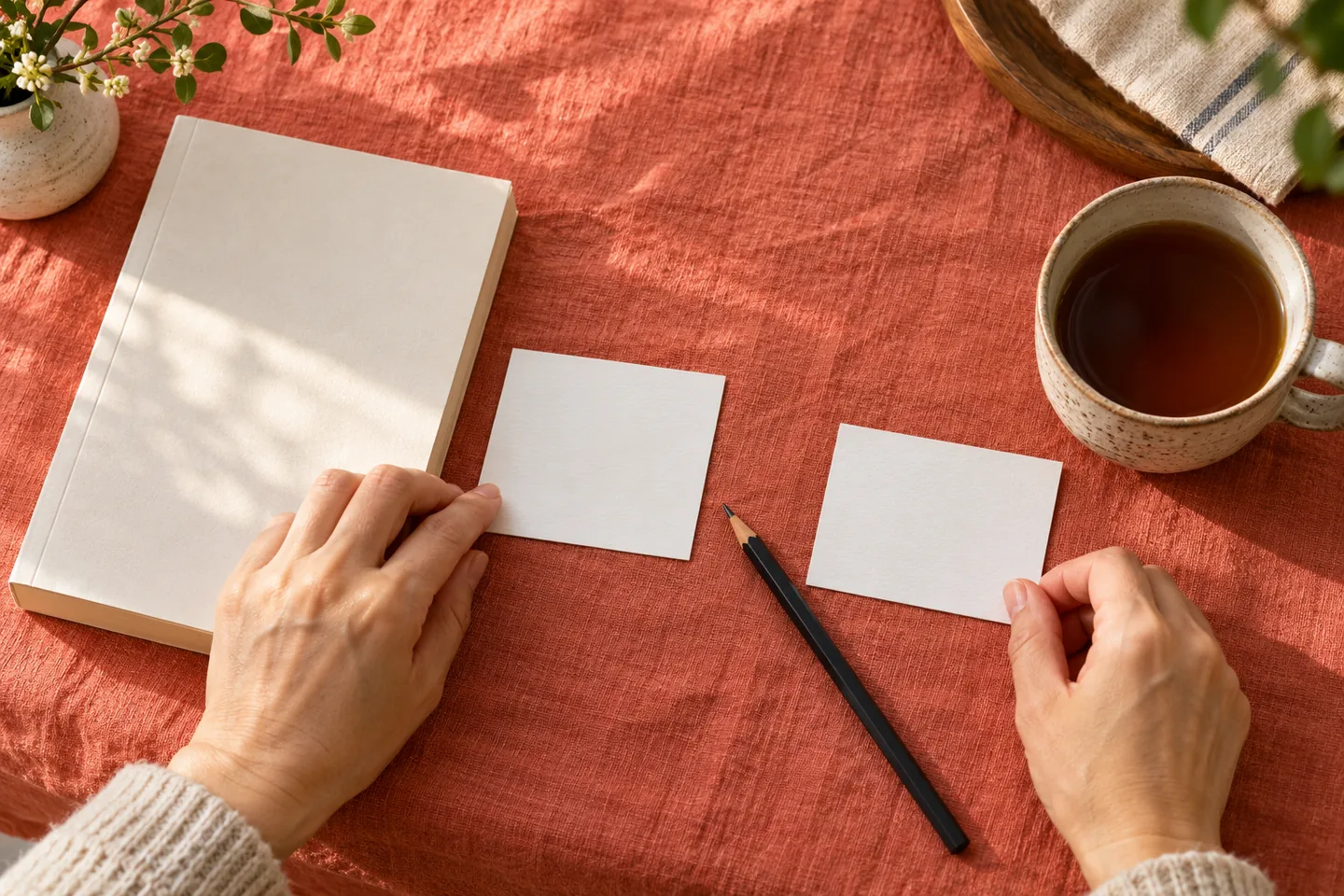
Write “drink tea” and “read a book” on separate cards. Place the tea card first and the reading card second. Your intended message is now fixed: tea comes before reading. This physical order represents the events, not the order in which words must appear in the Japanese sentence. Keep that distinction visible while you choose the expression connecting the two actions.
Here is the first model: 本を読む前に、お茶を飲みます。 Read it as ほんをよむまえに、おちゃをのみます: “I drink tea before reading a book.” The reading action appears early in the sentence, but tea happens first. The phrase 本を読む前に locates the tea drinking before the reading. Do not decide the event order simply by following the Japanese words from left to right.
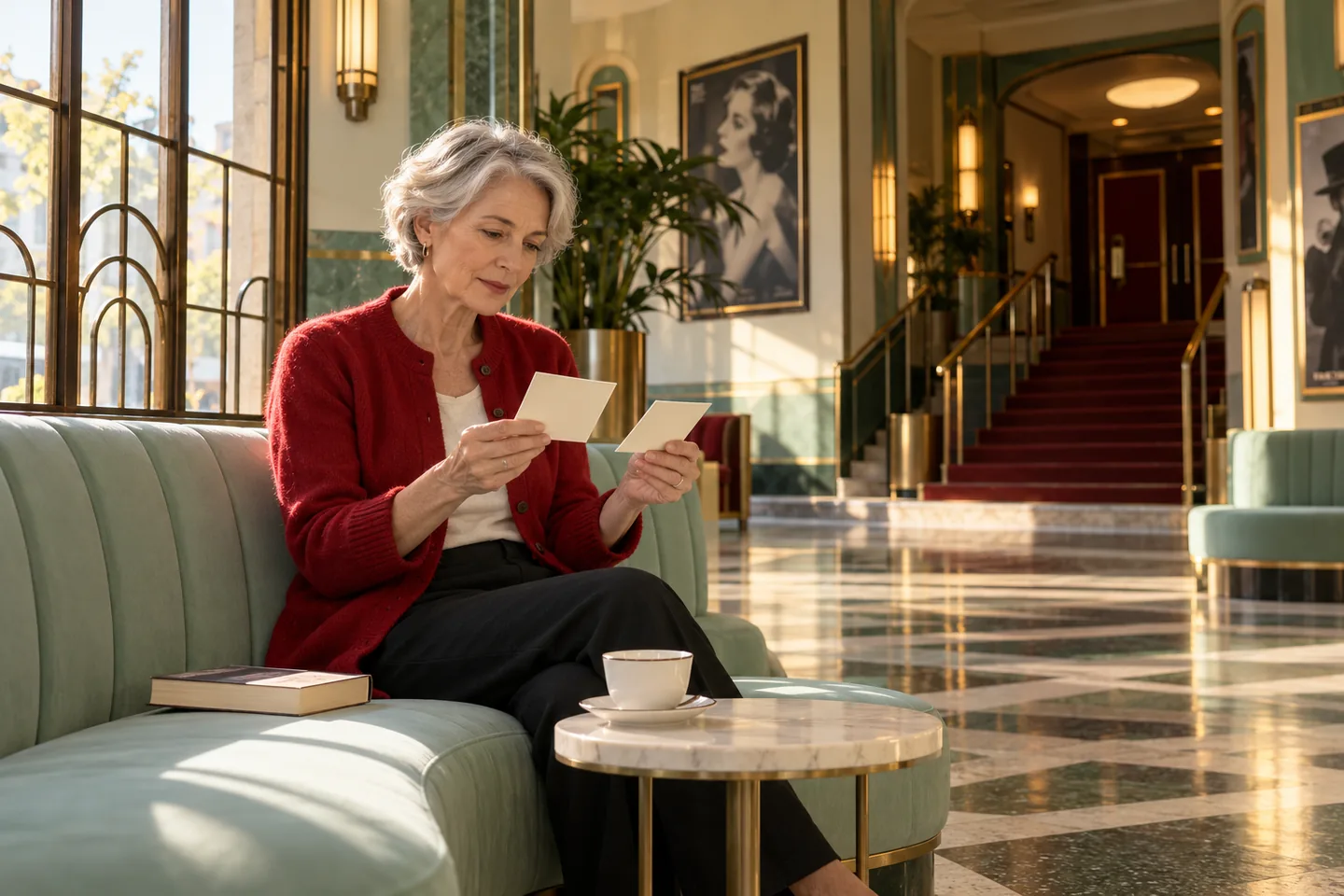
Now point to the cards while explaining the sentence in your own language. If you point to the book first, stop and reread the connection rather than memorising the mistaken sequence. A useful initial check is to identify the action described at the end, then ask where the preceding time phrase places it. This gives the grammar a concrete meaning before you practise producing it from memory.
Use the dictionary form before mae ni
In the affirmative action pattern introduced here, the verb before 前に takes its dictionary form. The model therefore uses 読む, yomu, “read”: 本を読む前に. Keep the object 本を attached to that verb when marking the phrase. 前に is read まえに, mae ni, and tells you that the following action occurs before the event named in that phrase.
Do not insert の between this verb and 前に, and do not carry the polite ます ending into the connection. You are joining a small verb clause to a time expression. The final 飲みます gives the complete model its polite ending. If dictionary forms are unfamiliar, review this part of sentence structure separately before trying a larger collection of verbs; recognising one form reliably is more useful than guessing several.
York University's Japanese teaching notes present the dictionary-form connection before mae ni and contrast it with the ta-form connection before ato de. They also show the pattern in sentences whose main event is past. Use that contrast to check the construction rather than relying on the English word “before” alone. In your notebook, preserve one complete model and underline only 読む前に so you can find the relevant boundary quickly.
Use the ta-form before ato de
Move the reading card before the tea card. The message changes to 本を読んだあとで、お茶を飲みます。 Its kana reading is ほんをよんだあとで、おちゃをのみます: “I drink tea after reading a book.” Reading is completed before the tea drinking in this model. The connector is あとで, ato de; you may also encounter the spelling 後で in this use.
The verb connection is now 読んだ, yonda, the ta-form of 読む. It is not formed by adding the syllable ta to the unchanged dictionary form. Different verbs have different changes, so check the whole form and reading together. A dictionary can help you confirm the base verb; a reliable conjugation reference is useful when the resulting form is unfamiliar. Avoid turning a spelling guess into a repeated practice example.
Compare the two models with the same nouns and final action. 読む前に places tea before reading; 読んだあとで places tea after reading. The verb change belongs with the connector, not with an independent decision to set the whole sentence in the past. Leave both cards in view until you can explain the contrast without looking at an English translation. Only then cover the Japanese and try writing it yourself.

Keep noun and verb connections separate
A time expression can also follow a noun naming an event. For example, 授業の前に、お茶を飲みます。 Read じゅぎょうのまえに、おちゃをのみます: “I drink tea before class.” Here 授業, jugyō, is the noun “class” or “lesson,” and の connects it to 前に. This is a different connection from the verb clause 本を読む前に, where that extra の is absent.
For the other order, use 授業のあとで、本を読みます。 The reading is じゅぎょうのあとで、ほんをよみます: “I read a book after class.” Class precedes reading. Keep the noun phrase 授業のあとで together when checking the sentence. The Tuttle grammar answer notes explicitly distinguish the noun connection with の from the clause connection without it, alongside examples of the two verb forms.
Sort your practice cues into two columns: an event noun such as “class,” and an action clause such as “read a book.” Choose the connection only after deciding which kind you have. This prevents a common mixed construction in which you remember の from a noun example and attach it to a verb. Use the source beside this explanation to verify the boundary, then return to the complete sentence rather than practising isolated particles alone.
Separate yesterday or tomorrow from relative order
Consider 昨日、本を読む前に、お茶を飲みました。 Read きのう、ほんをよむまえに、おちゃをのみました: “Yesterday, I drank tea before reading a book.” The final 飲みました reports the tea drinking in the past. 読む remains in the dictionary form before 前に. Changing it merely because the story concerns yesterday would confuse the relative connection with the time of the overall report.
Now take a plan: 明日、本を読んだあとで、お茶を飲みます。 Read あした、ほんをよんだあとで、おちゃをのみます: “Tomorrow, I will drink tea after reading a book.” The ta-form 読んだ does not say that the reading has already happened at the moment of speaking. In this connection, it presents reading as completed before the tea drinking within tomorrow's sequence. The time word and context establish the future plan.
Draw two separate marks on your paper: one for the day of the situation, another for the order of its actions. Move the whole two-card sequence from yesterday to tomorrow while keeping the internal order unchanged. Then check the main ending and the connector's verb form separately. This small visual separation helps you diagnose whether an error concerns the report's time, the order, or the form needed immediately before the connector.

Check meaning, connection and ending in that order
Start a new attempt with an intention written in your own language: “Tea first, reading afterwards; a plan for tomorrow.” Choose the sentence that communicates that sequence. Do not begin by choosing a Japanese verb ending and hoping that the intended meaning follows. Once you have written the sentence, hide your original cue and reconstruct the event order from the Japanese alone. The two versions should agree.
Next inspect the word immediately before the time expression. Is it a verb clause or an event noun? If it is an affirmative verb clause in these models, check dictionary form before mae ni and ta-form before ato de. If it is the noun 授業, check the の connection. Finally inspect the main sentence ending against the intended report or plan. Treat these as three distinct checks so a correct ending cannot conceal a reversed sequence.
Record a correction precisely. “Wrong grammar” gives you little to revisit; “I put the reading first although my sentence says before reading” identifies a meaning error. “I used the noun connection after a verb” identifies a connection error. If a word reading caused the problem, look up the complete word with its context instead of guessing from one character. Keep the original attempt beside the repair so the next review tests the actual difficulty.
Read and listen for the sequence rather than one word
Choose a short, trustworthy passage or recording with a clear context. On the first pass, identify the two events and say which happens first. On a later pass, locate the expression that establishes the relationship. When a transcript is available, compare its wording with your interpretation. Hearing mae or ato is a clue, but the surrounding phrase still matters; do not build a whole account from one recognised sound.
Use a reading passage to practise the same skill without playback pressure. Mark the event noun or verb clause and the main action in different ways. Write a two-step summary before translating the complete sentence. If the summary disagrees with the context, return to the connector and its boundaries. A short passage that you can explain accurately is a better practice choice than a long text whose sequence you repeatedly guess.
With a partner, give one simple sentence and ask them to arrange the two cards. Then swap roles. The arrangement provides a visible comprehension check; it is not a test of how quickly someone can name a grammar label. If your partner chooses the opposite order, compare the intention, the actual wording and the interpretation together. Ask for an explanation of the connection instead of accepting an unexplained correction as a new rule.

Change one feature and finish with a usable record
For a final exercise, keep the two actions and change only the order. Write one sentence placing tea before reading and another placing it after reading. Check both against the models, then add yesterday to one and tomorrow to the other. This staged exercise shows whether you can preserve the relative connection while changing the situation's time. It also keeps vocabulary changes from masking the source of a mistake.
Finish with a compact record: the intended order, the complete checked Japanese sentence, its kana reading and one note about the connection. On a later day, look only at the intention and produce the sentence again. Compare meaning first, then form. If you hesitate at 読んだ, review that verb form specifically; if you reverse the cards, return to the meaning contrast. There is no need to restart every part of the lesson after one local error.
These models cover a useful beginning, not every way Japanese expresses sequence. Other expressions, including てから, have their own uses and deserve separate examples in context. Do not replace every “after” automatically with whichever pattern you learned most recently. Your immediate goal is smaller and practical: communicate which of two actions comes first, connect the preceding word correctly, and keep that relationship clear when the overall time changes.