

Japanese comparisons become confusing when you know the adjective but lose track of the two things being compared. You want to say that this book is cheaper than that one, yet the sentence you build gives the opposite message. Memorising a longer formula will not necessarily repair that reversal. First identify the item you are describing, the reference item and the property that matters.
This guide turns that meaning check into a small study loop: a verified model, your own attempt, feedback, later review and a short exchange. KanaWay is an upcoming app. Its described grammar, practice, dictionary and review path can support the loop when available; the personal cues below stay on paper. No custom import, release date or special comparison feature is assumed.
Give Japanese comparisons one clear property
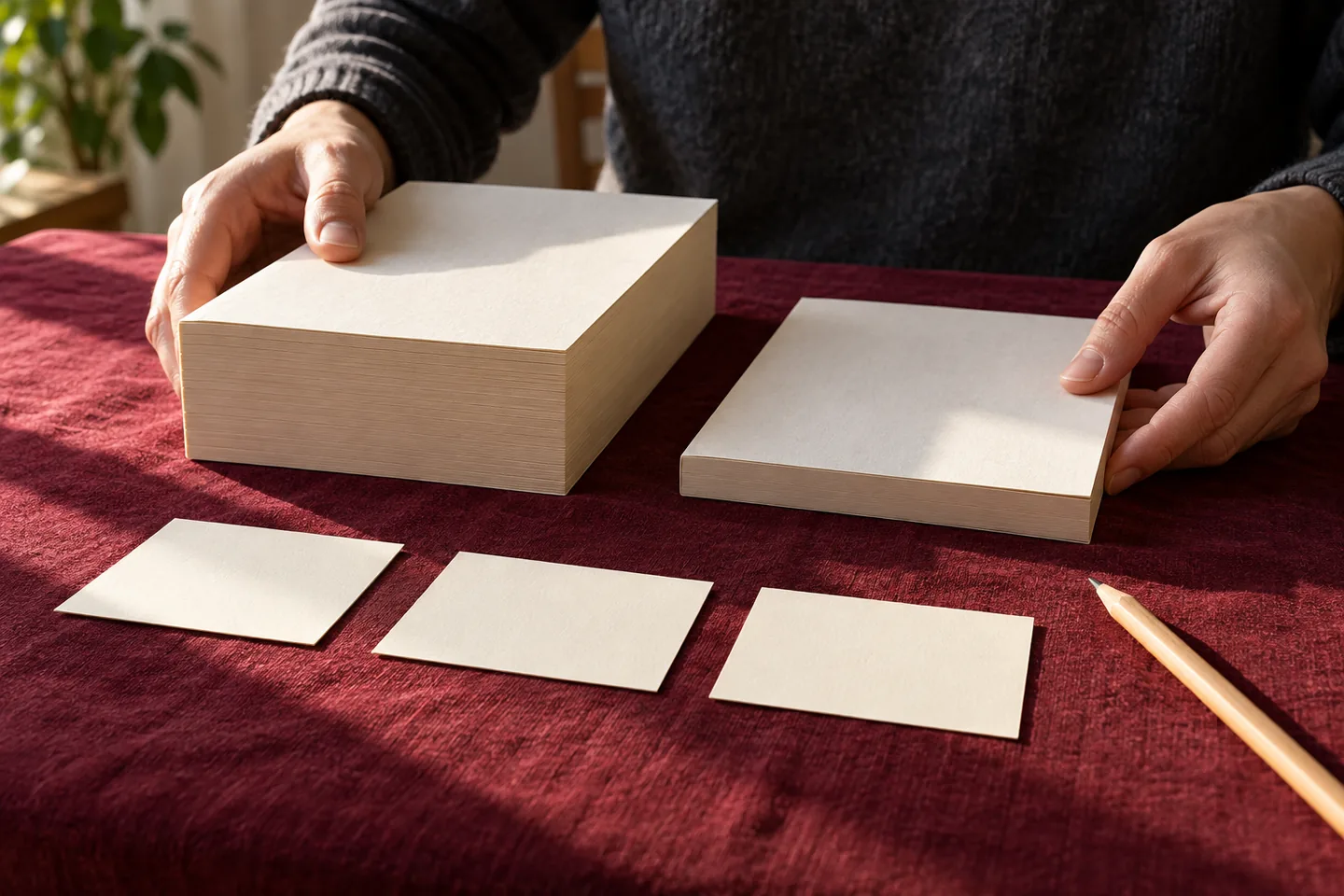
Place two objects in front of you, or draw two simple boxes on paper. Name them “this book” and “that book.” Choose one property, such as price, and decide which book is cheaper in your imaginary situation. Do this in your own language before writing any Japanese. The factual message should remain stable while you work on the grammar around it.
Write three short notes: the item being described, what you compare it with, and the property. These notes are a meaning check rather than an alternative Japanese word order. If the property changes from price to weight halfway through, start a new cue. A book can be cheaper but heavier. Calling one choice “better” without saying why hides the distinction your sentence needs to communicate.
In KanaWay’s described grammar path, begin with an explanation and a complete example that matches a two-item comparison. Keep your paper cue beside it. Before attempting practice, explain what the example says about each item. You are checking comprehension, not racing to reproduce its visible shape. If the available material covers a different comparison pattern, finish that explanation separately instead of treating every comparative expression as interchangeable.
Locate the reference immediately before yori
A simple model is この本はあの本より安いです。Its kana reading is このほんはあのほんよりやすいです, and the meaning is “This book is cheaper than that book.” Here あの本より supplies the reference: that book. この本 is the topic being described, and 安い gives the price comparison. The imagined prices establish the situation; the example makes no claim about real books on sale.
In this model, より follows the reference item. Do not identify the cheaper book by looking only at whichever noun appears nearest the adjective. Mark the whole reference phrase and then ask what the statement says about the other item. The adjective does not acquire an English-style comparative ending here. The surrounding construction establishes the relationship, while 安い remains the adjective you already recognise.
The Japan Foundation’s Irodori lesson12 gives a practical setting for comparing products and asking which option has a property. Use its grammar note to verify the relationship of the two sides. For your first attempt, retain the same two objects and the same property. Changing everything at once makes it difficult to tell whether an error came from the comparison, unfamiliar vocabulary or an unclear intention.
Read no hō ga without losing the direction
You can express the same comparison as あの本よりこの本のほうが安いです。Read it as あのほんよりこのほんのほうがやすいです: “This book is cheaper than that book.” The reference is still that book. This time この本のほうが explicitly presents this book as the side with the greater degree of the stated property. “Cheaper” concerns price; it does not mean that the book wins every possible comparison.
Keep the noun connection visible: この本のほうが. Do not remove の when practising this noun-based model. The spelling 方 can occur for ほう, but using hiragana consistently in your initial notes keeps the grammar task separate from learning another character reading. Likewise, do not automatically carry this noun pattern into verb phrases; those need their own checked explanation and examples.
Now compare your two written versions. Underline the reference in both and point to the cheaper book. If both sentences point to the same object, the core message has survived the change. Say the meaning aloud in your own language before checking the Japanese again. This gives you a practical way to catch reversals that can remain hidden when you only compare particles against a memorised formula.

Attempt one sentence and diagnose the feedback
Close the model and use the paper cue to build one comparison. When working with KanaWay’s described practice and feedback, read the explanation of an incorrect answer before trying again. Decide whether you reversed the two objects, dropped a noun connection, selected the wrong property or did not recognise a word. These are separate repairs. Repeating the whole lesson may not address the particular gap.
For a reversal, return to the cue and mark the reference before より. For a vocabulary gap, check the complete word and its reading. 安い, やすい, is about being inexpensive; 軽い, かるい, concerns lightness in a weight comparison. Choose the word that matches the intended message rather than treating several positive-sounding adjectives as substitutes. Keep the comparison about one stated property throughout the attempt.
After checking, make a second attempt with the answer hidden. You do not need a large set of new sentences. A correct reconstruction of the original meaning is more informative than clicking the right option after repeatedly seeing it. Record the error type on paper and retain the verified model as the answer key. Do not invent a score improvement or assume that the app stores your personal diagnostic notes.
Turn a two-item question into a matching answer
A useful question is この本とあの本と、どちらが安いですか。The kana is このほんとあのほんと、どちらがやすいですか: “Which is cheaper, this book or that book?” An answer can be この本のほうが安いです, “This book is cheaper.” The question has already made the pair clear, so the response can leave the reference unstated when the context supports it.
Portland State University’s Beginning Japanese for Professionals, Book2, explains two-item questions and answers with より and ほう in section8-3-1. It is useful for checking how a response connects to a question. Your exercise should preserve that connection. A sentence may be grammatical but answer a different question if you switch from price to convenience, or introduce a third object without telling your listener.
Practise one exchange in both roles. First ask from a cue showing the pair and the property; then cover the question and answer from the imagined situation. Before checking the wording, identify which book the answer selects. Do not shorten the reply so far that you can no longer tell what is being compared. Longer is not automatically better, but enough shared context must remain for the listener to recover the message.

Keep an observation distinct from a preference
Price, weight and convenience describe different criteria. A comparison about one of them does not automatically express what you personally want to choose. In your notes, separate “Which is cheaper?” from “Which would I prefer?” You might choose a more expensive book for another reason. Staying with a concrete criterion makes the first grammar exercise easier to verify without reducing real decisions to a single number.
If you later practise preferences, open a checked explanation for that task. Do not assume that every sentence ending in いい is a literal measurement or that every phrase containing ほう gives advice. For this session, avoid expanding into recommendation constructions, negative comparisons or a ranking of several options. Each introduces additional choices that can obscure the simple reference relationship you are trying to stabilise.
KanaWay’s described dictionary and grammar tools can support a targeted repair when the available content fits. Search for the particular word or construction that caused the difficulty, then return to your original cue. The goal is not to browse every comparison page. A useful repair ends when you can explain why the checked sentence matches the intended situation and then reproduce it without leaving the explanation visible.
Review the meaning before listening or speaking faster
At a later review, start with the paper situation rather than the full model. Identify the property and reference, produce the comparison, then check it. KanaWay’s described review path can bring previously studied material back; your own cue remains an external exercise. Do not assume it can be imported or scheduled automatically. A small number of clear attempts is enough to reveal whether the reversal has returned.
When a matching recording is available in your learning material, listen once for the two items and again for the comparison. Point to the item described by the answer before looking at a transcript. Then check the complete line and its reading. Listening and recalling a written formula are different tasks. Hearing an adjective correctly is not sufficient if you assign the property to the wrong object.
For speaking, slow down enough to keep the reference phrase together. Ask a partner what they understood in a shared language: which item was cheaper, and compared with what? Their interpretation can reveal a meaning error that your own fluent-sounding repetition missed. Avoid treating one successful exchange as proof of general fluency. It shows that this particular message was understandable under these conditions, which is already a useful result.

Finish with a comparison you can explain tomorrow
Close the session with one question and one checked answer about a single pair of objects. Keep the three-part cue, the Japanese model, its kana reading and the correction you needed. You do not have to copy a whole grammar chapter. The record should let you reconstruct the exercise tomorrow without guessing what your old labels meant or which property you had intended.
In the next session, change only one element: the object pair or the property, after verifying the new vocabulary. If the reference relationship becomes uncertain, return to the original pair and explain it again. Gradual changes help you identify what caused a difficulty; they are a suggested practice design, not a guaranteed learning speed. There is no required number of comparisons to master in one sitting.
The app-assisted loop is explanation, attempt, feedback, a focused repair, later review and a short listening or speaking transfer. KanaWay remains upcoming, so the paper exercise and checked public teaching materials work now. When the app becomes available, use only content and tools it actually offers. Success here means keeping the intended relationship intact: you can name the reference, identify the property and explain which item your Japanese sentence describes.