
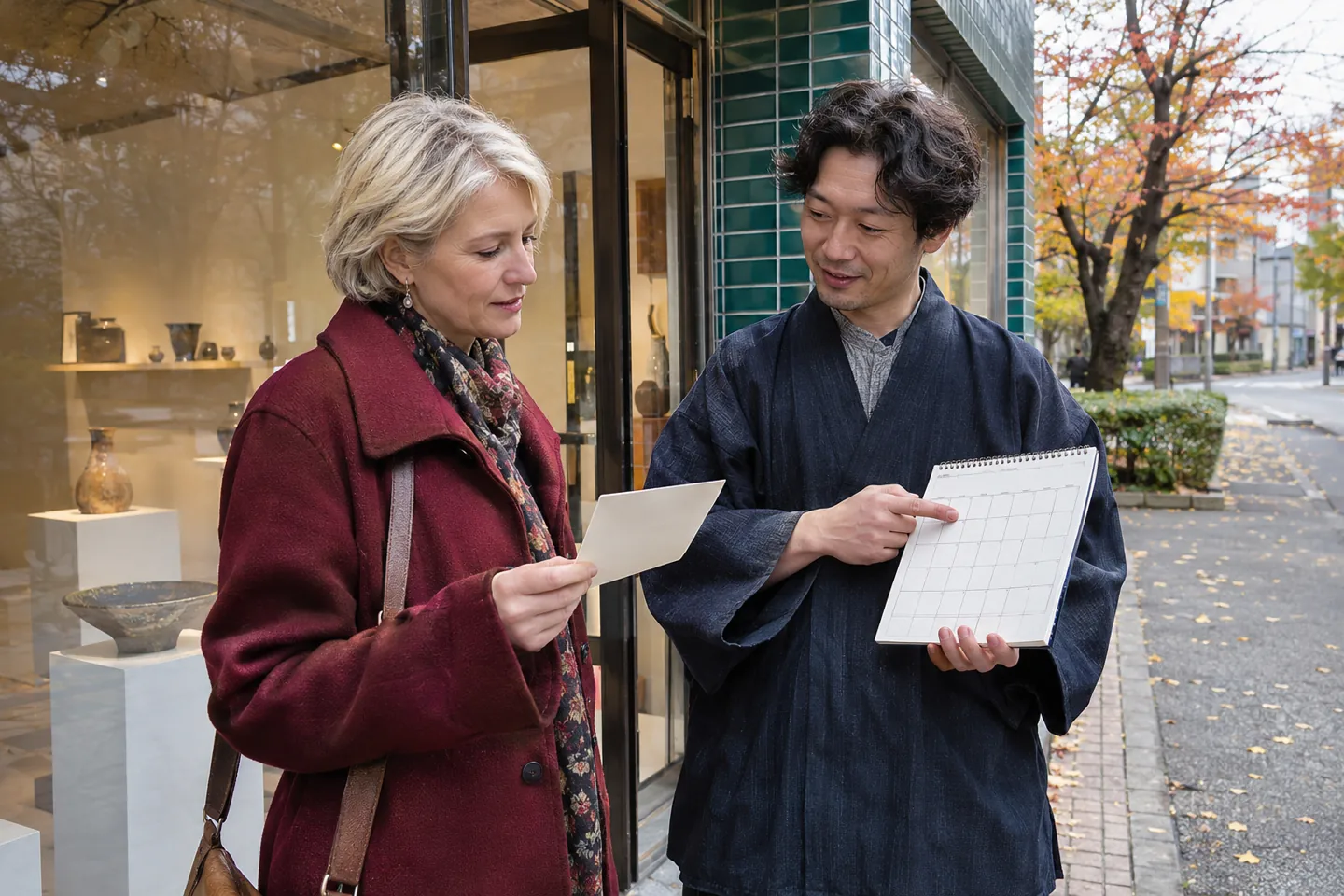
Japanese dates become useful when you can match something you hear to the right square on a calendar. Recognising the numbers on an invitation is only half the task. You also need to say the month, retrieve an unfamiliar day reading and check that your partner meant the same date.
This guide builds that skill with a small calendar and a handful of invented event cards. You can practise alone, then ask someone to read the dates back to you. Start with month and day; add the year only when the situation requires it. The aim is a confirmed appointment, rather than a fast recital of every number you know.
Read Japanese dates from the month to the day
On a Japanese date written with 年, 月 and 日, the units tell you which number belongs to the year, month and day. A full date runs from year to month to day. For the first exercise, use an invitation that shows 4月14日. Separate it into 4月 and 14日 before trying to pronounce the whole expression. That keeps a long number string from becoming a guessing exercise.
Say 四月十四日 as しがつじゅうよっか: April fourteenth. The reading of 四 in this month is し, and the day has its own established form. You do not get the result by reading each written character in isolation. Underline the month once and circle the day on your practice card. Then point to the corresponding square on a calendar whose month you have already checked.
The MEXT handbook's calendar reference sets out the special day readings and illustrates full dates. Use it as a reference while you prepare the exercise, then cover the reading when you attempt the card. A reference is most helpful when you know exactly what you need to check. Here that means identifying the units first and checking the spoken form second, rather than copying a whole line without understanding its parts.
Give the month its calendar reading
Months use a number followed by 月, read がつ in this setting. The calendar sequence is いちがつ, にがつ, さんがつ, しがつ, ごがつ, ろくがつ, しちがつ, はちがつ, くがつ, じゅうがつ, じゅういちがつ and じゅうにがつ. Give extra attention to April, July and September: 4月 is しがつ, 7月 is しちがつ and 9月 is くがつ. Do not replace those with another familiar reading of the numeral merely because it works elsewhere.
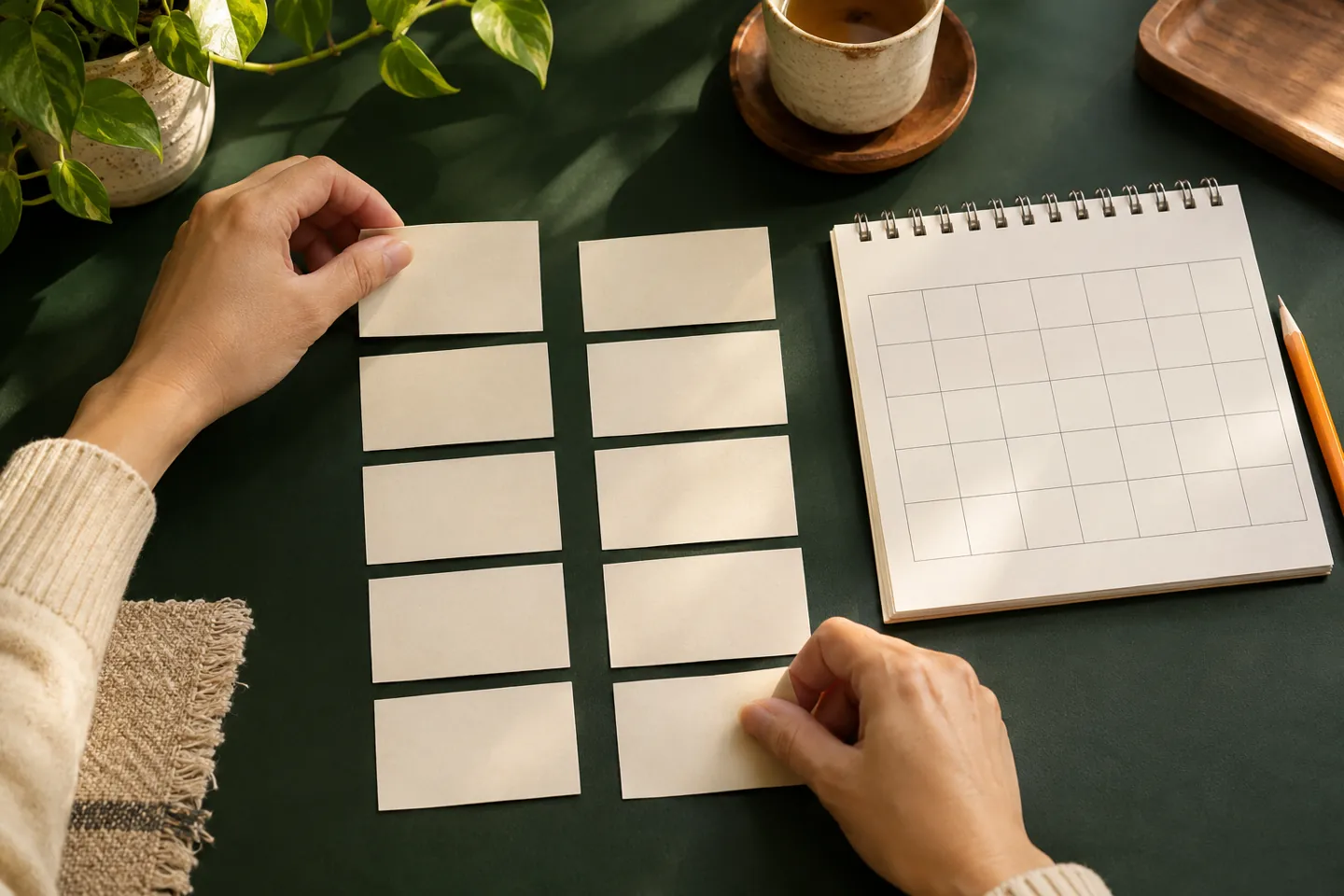
Make three month cards for 4月, 7月 and 9月. Read one, cover it and write the month number you intended. Check both directions. Saying しがつ from a written 4月 is a different task from hearing しがつ and selecting April. Practising both prevents a neat written list from hiding a listening gap. The Japan Foundation's Irodori lesson provides a month and date reference alongside activities for reading event notices.
If the kana themselves slow you down, use the hiragana and katakana guide before adding more dates. You can keep a reading beside the card while learning, then fold it out of sight. Avoid making romanisation the only answer you recognise. A short kana cue lets you connect the sound to the same writing you will meet in a Japanese learning resource.
Learn the exceptional days as small groups
The first ten days have these readings: 1日 ついたち, 2日 ふつか, 3日 みっか, 4日 よっか, 5日 いつか, 6日 むいか, 7日 なのか, 8日 ようか, 9日 ここのか and 10日 とおか. Three later dates also need deliberate attention: 14日 じゅうよっか, 20日 はつか and 24日 にじゅうよっか. Keep this as a reference strip, rather than requiring yourself to master every item before you can use one date.
For the remaining dates, use the number with にち, checking the complete reading rather than assembling sounds at random. For example, 11日 is じゅういちにち and 30日 is さんじゅうにち. Keep your reference available when adding a new number.
Begin with four cards, perhaps 1日, 4日, 14日 and 20日. Look, say, cover and retrieve. Mix the order each time. If you always move from the first to the twentieth in the same sequence, the previous card can become the cue for the next answer. You want the written date itself to trigger the reading. Add another card only when you can identify what your current mistakes are.
Record a narrow correction. If 14日 became よっか, you kept the fourth-day sound but lost the ten. Place 4日 and 14日 together, say each and point to separate squares. This is more useful than labelling the whole topic difficult. You have found a contrast you can practise directly, with an observable answer on the calendar.

Keep date, weekday and duration separate
A question about the day number is different from a question about the weekday. 何日ですか (なんにちですか) asks which day of the month in a calendar context. 何曜日ですか (なんようびですか) asks which weekday. If someone asks for the date, answering only “Tuesday” leaves part of the information unresolved. Put a small label beside each practice question so that you choose the kind of answer before retrieving its Japanese form.
The same written characters can also appear in expressions of duration. In particular, 一日 is ついたち when it means the first day of the month, but いちにち when it means one day. This guide's cards all represent positions on a calendar. Mark that context clearly instead of deciding that 日 always has one reading. When a new example is about how long something lasts, check it separately in the Japanese dictionary.
Try two fictional notes: an exhibition on the first of April, and a task that takes one day. Keep the date on a month grid and the duration beside a simple start-to-finish line. The layouts help you ask what the number is doing in the message. You are practising interpretation before pronunciation, a useful habit whenever familiar written forms appear in a new context.
Ask for the whole date and confirm the answer
For the practice event, ask 何月何日ですか (なんがつなんにちですか): “What month and day is it?” Your partner answers 四月十四日です (しがつじゅうよっかです), “It is April fourteenth.” Repeat 四月十四日ですか with a checking tone, then wait for confirmation. The repetition gives your partner a chance to correct a month or day before you write the appointment down. It is not a demand to repeat every sentence in a real conversation.
Use a fictional exhibition, meeting or class rather than a real private appointment while learning the pattern. Prepare the date in digits on one side and a checked reading on the other. One person holds the card; the other writes what they hear. Compare only after the checking exchange. If both people can see the original throughout, you may be reading together without actually testing whether the spoken date was understood.
When you miss just one part, return to that part. You can ask もう一度お願いします (もういちどおねがいします), “Once more, please,” then listen for the month before the day. Write a temporary question mark where the information is missing. This makes the next listen purposeful and avoids turning a plausible guess into a confirmed plan.
Listen to contrasts on the same calendar
Set up two invitations for April fourth and April fourteenth. Both contain a familiar fourth-day ending, but they point to different squares. Ask a partner to read one complete date. Touch the square you heard, repeat the date and then check the card. Reverse the roles after a few turns. Your partner's task is to understand your date, so speaking and listening both have a concrete outcome.
Next contrast 4月14日 with 7月14日. Now the day stays fixed and the month changes. Work on one contrast at a time before mixing month and day changes in the same round. The Japanese listening practice guide offers ways to give a short recording a specific purpose. Here the purpose is selecting and confirming a calendar position, not writing down every sound from a long conversation.
If practising alone, record several checked dates and leave the file until another session before listening. Keep a written answer key apart from the calendar. Do not claim success just because your own recording feels familiar. Check which square you selected and which date you repeated. If you cannot yet distinguish two recordings, reduce the set and consult a reliable pronunciation model before recording them again.

Finish with a usable invitation-reading routine
Take an unfamiliar practice invitation and identify the month and day without saying them. Point to the intended square, check any reading you do not know and then cover the reference. Read the date aloud as one expression. Finally, have a partner confirm it through the short exchange. This sequence separates a written recognition error from a reading error and from a listening error. Each calls for a different next exercise.
Keep your review note brief but informative: the printed date, your first attempt and the corrected reading. Add a reason only when it helps, such as “lost the ten” or “used the wrong April reading.” At the next session, try the problem card before looking at yesterday's correction. Then use it in a new invitation so that the skill travels beyond one memorised piece of paper.
You do not need to add every calendar convention at once. Years, era names, weekdays and appointment times can each become a later task. For now, leave with a small set of dates you can read, hear and confirm accurately. In a real exchange, check the year or time whenever it is unclear. The practice is complete when the shared plan is clear to both people, even if reaching that clarity took an extra question.