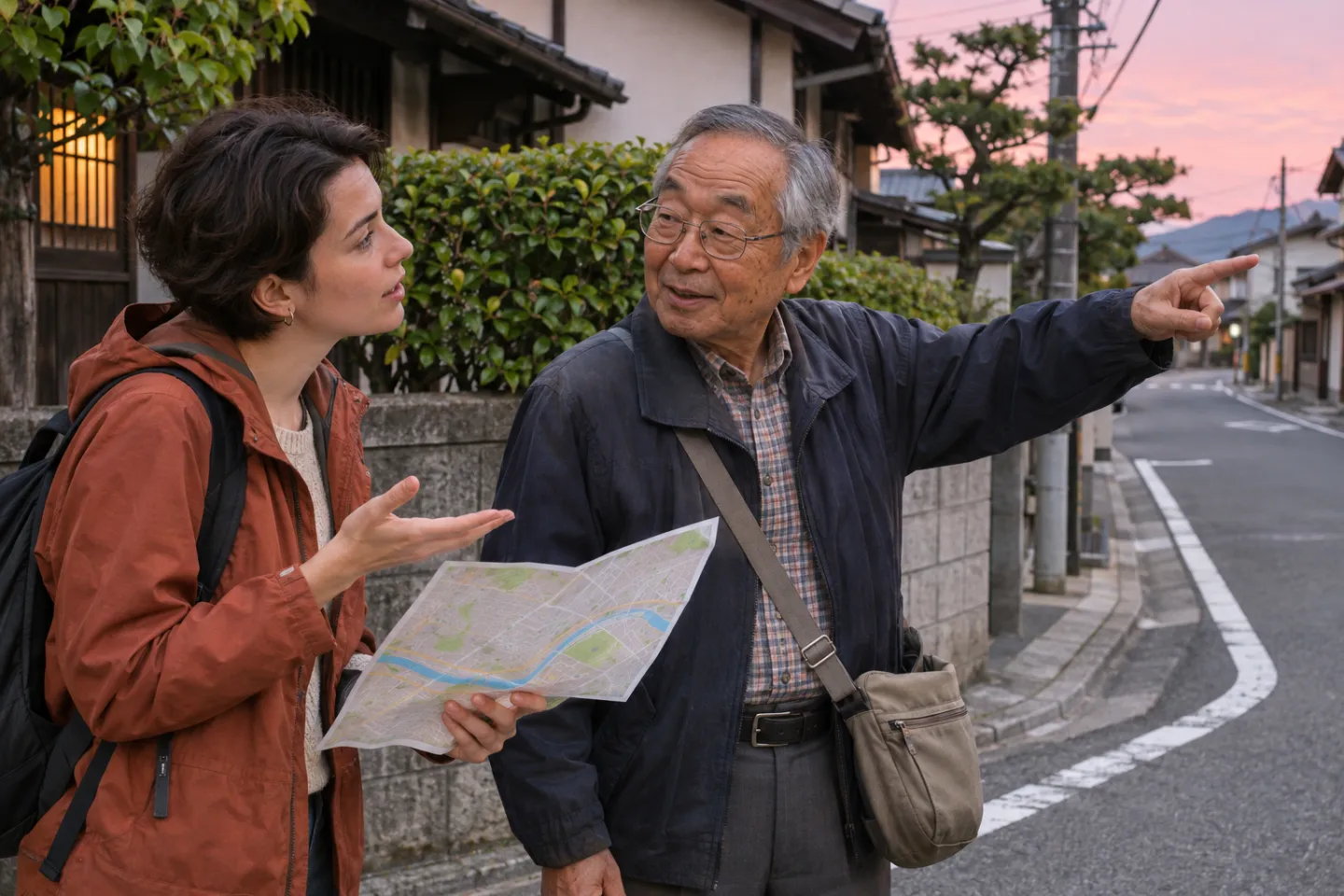
Japanese directions become difficult at the moment you get an answer. Asking where the station is takes one short sentence. The reply may contain a road, two junctions, a turn and a building on the far side. You recognise “right” and start walking, but you have forgotten whether that turn belonged to the first traffic light or the second.
Practise a route as a sequence you can check. Begin with a destination, catch the next action and its landmark, then repeat the part that decides where you turn. This guide uses a fictional neighbourhood, paper and a partner. You can also record the short lines and check your own sketch. The aim is to leave the conversation knowing the first useful step and where to ask again.
Listen to Japanese directions in small pieces
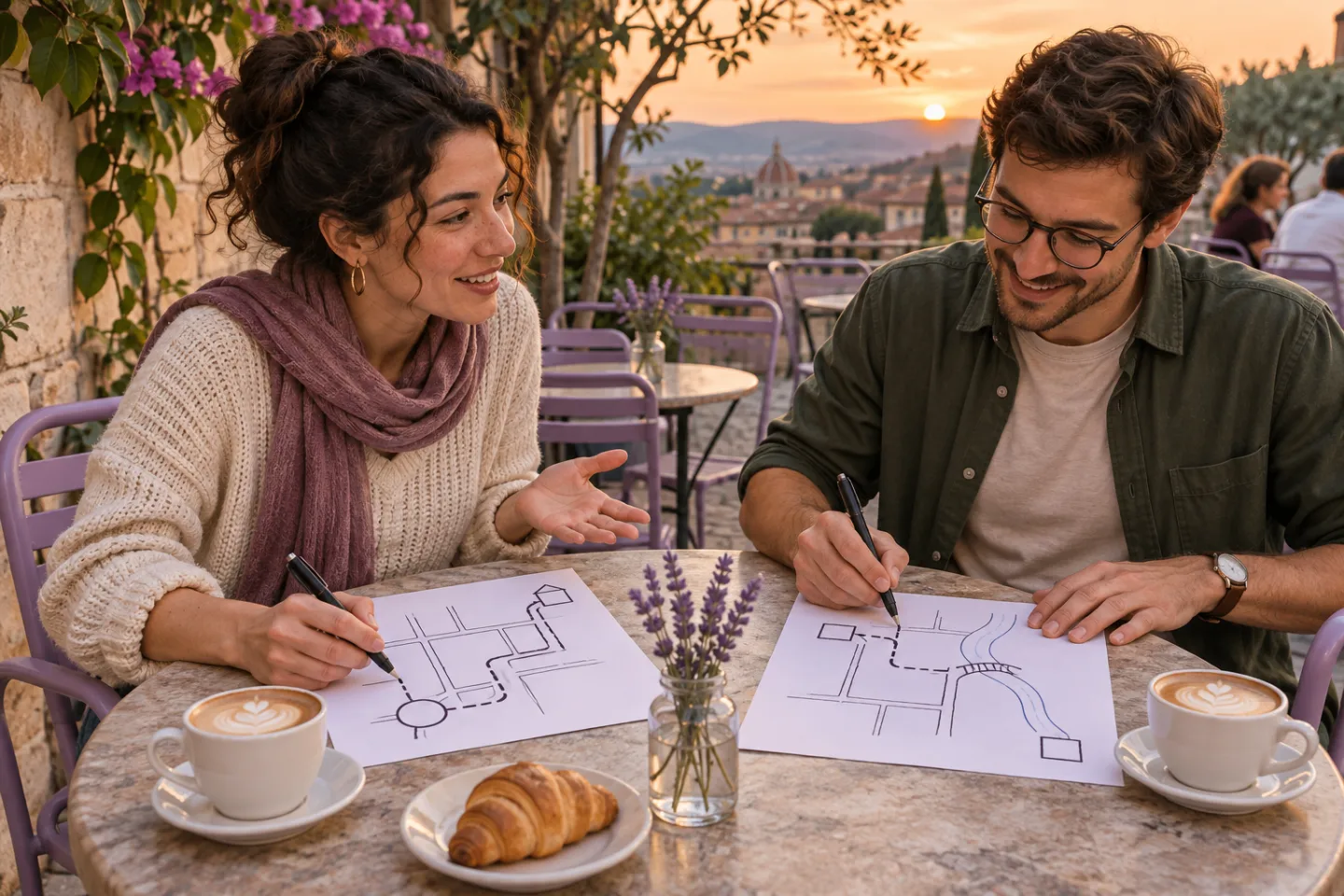
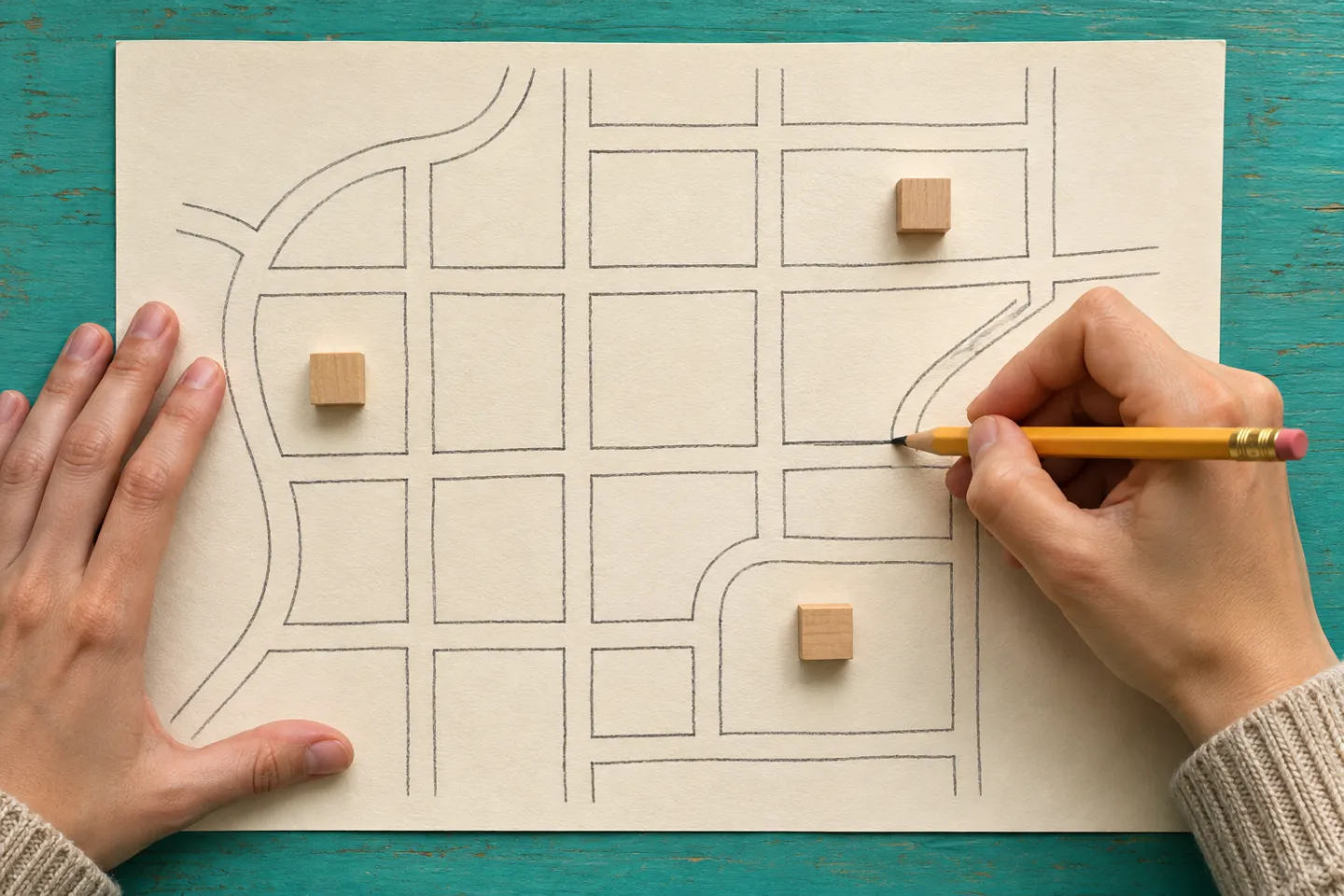
Draw a straight street with two junctions. Place a small square beside the second junction and decide that it is the post office. Stand a coin at the starting point. Your partner gives one step, pauses and lets you move the coin. In a second round they can connect the steps. This makes the listening task visible. You will see whether the difficulty was a missed word or an action attached to the wrong place.
The CLAIR plain Japanese guide includes a direction-giving example that breaks a longer route into shorter utterances. Use that idea in your rehearsal. One person gives enough information for the next move, the other confirms it, and only then do you add the next step. You can make the dialogue longer when the short exchanges work. The exercise does not depend on knowing the real layout of any Japanese city.
For your first round, keep the route to a straight segment and one turn. Ask the listener to point to the junction before moving the coin. If the wrong junction is chosen, repeat the landmark and the number together. Correcting the decision on paper is easier than remembering a full spoken paragraph and then trying to locate the mistake at the end.
Make the destination clear before the route begins
Use すみません、郵便局はどこですか (すみません、ゆうびんきょくはどこですか), “Excuse me, where is the post office?” For a station, 駅 (えき) replaces 郵便局. If more than one place might fit, give its name or show the address. A useful answer needs a shared destination. In a practice dialogue, write the destination on a card before asking. Keep the route hidden from the person who will listen.
The community-language textbook hosted by Japan's Agency for Cultural Affairs includes asking for a post office and following directions. It provides a model of destination-led exchanges. Use your own drawn neighbourhood for the exercise. There is no reason to memorise an entire example route when your next conversation will start from somewhere else. If you are unsure how to read the destination, check it in the Japanese dictionary before the role-play.
Begin each round by having the speaker repeat the destination they heard. This gives the listener a chance to correct it before a route is explained. In a real exchange you can point to the written place name and say it again. If the person recognises a different branch or building, resolve that first. A perfectly understood left turn can still lead to the wrong place when the two people are imagining different destinations.
Pair each action with its landmark
まっすぐ行ってください (まっすぐいってください) means “Please go straight.” 右に曲がってください (みぎにまがってください) means “Please turn right,” and 左に曲がってください (ひだりにまがってください) asks for a left turn. These short pieces become useful when you know where the action happens. In your sketch, put one mark at the junction where the speaker intends you to turn. Listen for that place along with the direction.
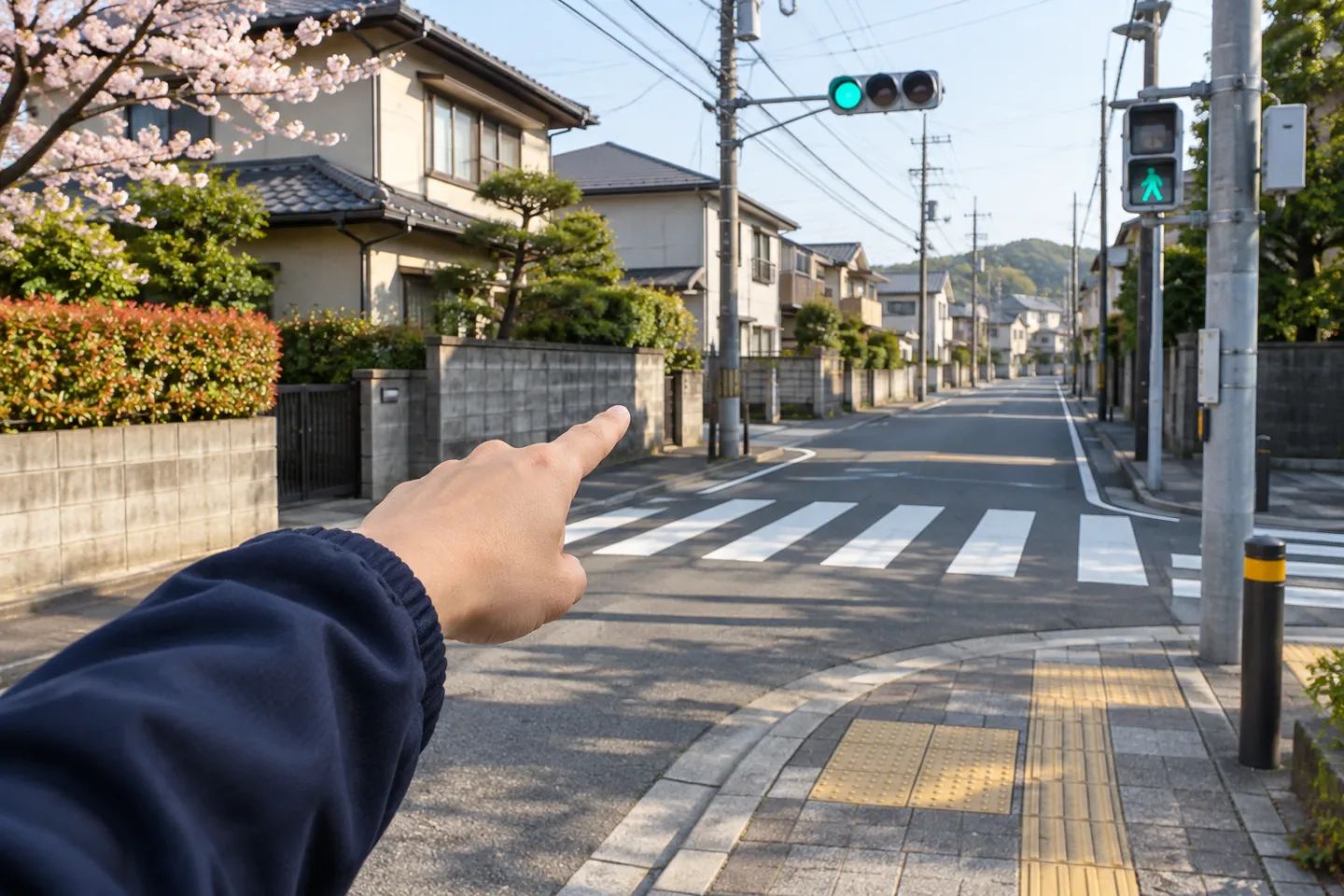
信号 (しんごう) refers to a traffic signal or lights in this setting. 次の信号 (つぎのしんごう) is the next traffic light. 二つ目の信号 (ふたつめのしんごう) is the second one. Say those last two phrases while pointing at different marks. The difference is easy to miss when you are concentrating only on 右 or 左. Count the lights along the route from your starting point in the exercise.
Use an original practice line such as 二つ目の信号で左に曲がってください (ふたつめのしんごうでひだりにまがってください), “Turn left at the second traffic light.” First identify the second signal, then draw the left turn. If you make both decisions at once, a familiar word may pull your pencil toward the nearest junction. The Japanese listening practice guide offers other ways to give each replay one specific question to answer.
Confirm the point that changes your next move
After hearing the line about the second light, say 二つ目の信号で左ですね (ふたつめのしんごうでひだりですね), “Left at the second traffic light, right?” The speaker can agree or correct the number or direction. Include both details when either could be wrong. A simple nod tells the other person that you are following, but it does not reveal which turn you understood.
If you missed the phrase, もう一度お願いします (もういちどおねがいします) asks to hear it again. To request slower speech, try もう少しゆっくりお願いします (もうすこしゆっくりおねがいします). In the role-play, choose whether you need a repeat or just a check of one detail. You might know it was a left turn but need to hear which signal. That is a smaller gap than losing the whole route.
Make correction a normal part of practice. Give your partner a route where the first and second junctions lead to different squares. Intentionally confirm the wrong one once and listen to their correction. Then move the coin to the corrected place. The exercise works when a correction changes what you do. Saying the confirmation politely is only one part of completing it.
Distinguish where you turn from where the building stands
A direction can describe movement or the destination's position. 左に曲がってください asks you to turn left. 郵便局は右にあります (ゆうびんきょくはみぎにあります) says that the post office is on the right. If you treat every mention of 右 as a command to turn, you can pass the building while looking for another junction. Listen to the verb as well as the direction.
On paper, use an arrow for 曲がる (まがる, to turn) and a square for a building described with あります. Your partner can read one instruction and one location statement. Draw the arrow first and then put the square on the appropriate side of the street. This gives you two separate things to check. If your turn was right but the destination square is on the wrong side, replay only the second statement.
The side depends on the direction you are facing along the route. Turn your paper or move the coin so that you are looking the same way as the walker. If your partner points across the table, check whether the gesture matches the route they described. You can review the distinction between movement and location in the Japanese grammar overview before trying a longer exchange.
Rebuild a route from a short recording
Record a destination question, two instructions and a final location statement. Leave a pause after each piece on the first version. Set the route drawing aside and listen with a fresh sheet. Write the destination, mark the first landmark and draw the next action. You can use English labels on your own notes. The task is to recover the route from the sound, so beautiful kana handwriting is not needed.
Check the sketch against the original after one complete attempt. Circle the first point where they diverge. Did you miss the count, switch left and right, or turn a location into an action? Replay the line that caused it. When that part is clear, restart from the previous correct junction and continue. You will preserve what you understood while repairing the part that broke the route.
In the next round, remove the long pauses and let your partner use an ordinary speaking pace. Keep the route familiar at first. Once you can follow it, change one feature, such as the side of the destination or the junction number. If every feature changes together, you may not know which listening skill needs attention. Ask one confirmation question before you check the full sketch.
Take one confirmed step into a real conversation
At a real starting point, make sure you and the person helping are referring to the same destination. Hear the first segment, repeat the landmark and action, and thank them once you have enough to proceed. If a route has more detail than you can hold, ask for the next part again. A map or written place name can help both people locate the same point while you talk.
Before walking away, picture what you expect to see next. You might expect a traffic light followed by a left turn, or a building on the right after a straight segment. When you reach that landmark, compare it with the instruction. If the scene does not fit, pause and ask again from a place you can identify. Knowing the name of the place you are standing beside gives the next person a better starting point.
For your final practice, let your partner choose a destination on a new three-junction sketch. Ask where it is, listen, confirm one important turn and draw the route. Then swap roles. You can count the task complete when the two sketches lead to the same building and both people can explain the step that was corrected.