

Japanese frequency adverbs can look easy on a vocabulary card and become difficult in a sentence. You recognise よく as “often” and あまり as “not very often,” yet produce an affirmative ending after both. Or you describe a habit with いつも because it was first on the list, even though the activity happens only occasionally. The missing skill is choosing a truthful message and building the whole sentence around it.
This guide connects that decision to a concrete study loop: a checked model, one attempt, useful feedback, a small review set and a short conversation. KanaWay is an upcoming app; the workflow below uses its described grammar, practice, dictionary and review path when available. Your personal routine notes stay on paper.
Japanese frequency adverbs begin with a real routine
Choose one ordinary activity that you can describe without researching new vocabulary. Reading, watching films or listening to music works better than a complicated hobby with an unfamiliar verb. Think about what you actually do across a normal stretch of days, not your best imagined week. Write a plain-language note such as “I read fairly often” or “I hardly watch television.” That note is the meaning your Japanese sentence must preserve.
Separate an activity’s frequency from your feelings about it. You can enjoy films but rarely watch them because you have little time. You can do a task regularly without liking it. If your note says “I love music,” it does not yet answer how often you listen. Add a distinct habit statement before selecting an adverb. This avoids turning every question about routine into an unrelated declaration about your favourite activity.
In KanaWay’s described grammar path, start from an explanation and a complete example before moving to focused practice. Choose material that matches the contrast you need rather than restarting a broad course to find one word. Keep the paper note beside you as an independent meaning check.
Use a small contrast instead of a percentage ladder
Begin with よく for an activity you do often and ときどき for one you do sometimes. Add あまり with a negative verb for something you do not do very often, then ぜんぜん with a negative verb for something you do not do at all in the context being discussed. The Japan Foundation’s Irodori Starter lesson 11 provides this beginner frequency contrast and complete examples. Use its grammar note as a checked starting model.
いつも commonly supplies “always” or an accustomed routine, while たいてい supplies “usually.” You do not need both in your first production set. More labels create more choices before the basic contrast is stable. Begin with often, sometimes and not very often; introduce the stronger end of the scale only when you can explain why the statement fits. A short set used honestly teaches more than six expressions chosen randomly from a chart.
Do not assign universal percentages to the words. A practice diagram can place expressions roughly from higher to lower frequency, but “often” does not encode the same numerical rate for every activity. Visiting a distant relative and drinking tea create different expectations. Describe your chosen context in ordinary language, then select a reasonable expression. If exact counts matter, that is a separate task requiring a suitable counting expression and a clear period of time.
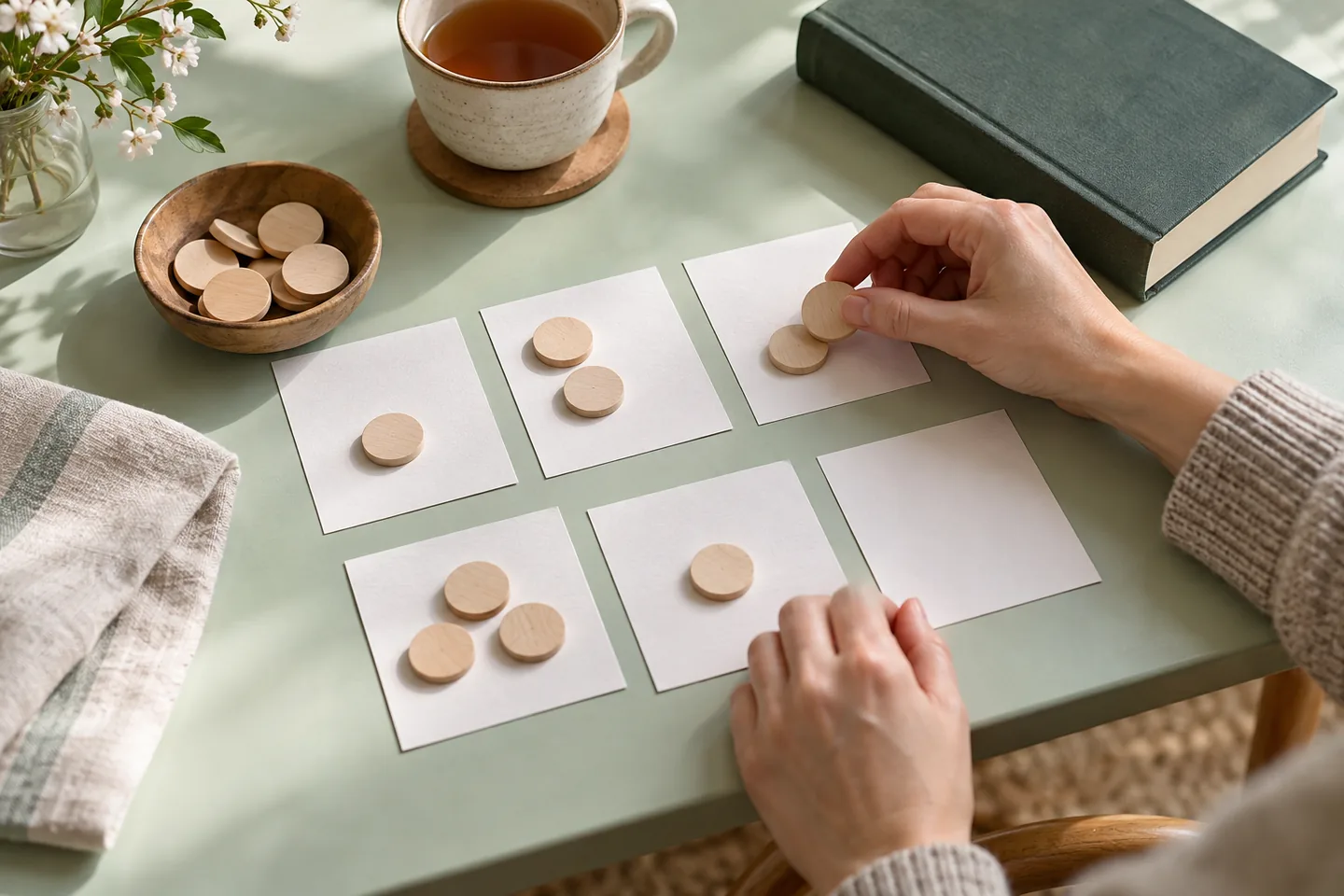
Keep the activity stable while you change frequency
Use よく音楽を聞きます。as one practice sentence: “I often listen to music.” Its kana reading is よくおんがくをききます. Change only the adverb to make ときどき音楽を聞きます。, “I sometimes listen to music.” The activity and affirmative verb ending stay the same. Read both against two different routine notes so that the change represents a difference in meaning rather than a substitution performed without thinking.
Now prepare a second activity: ときどき映画を見ます。, read ときどきえいがをみます, “I sometimes watch films.” Here 見ます is read みます, whereas 聞きます in the music sentence is ききます. Check those complete combinations before mixing several activities. If the verb is unfamiliar, look it up through the dictionary path and return to the original sentence. Do not let an unrelated word search become a reason to abandon the small contrast you were practising.
For your first exercise, place the adverb before the object-and-verb phrase, as in these models. This is a useful starting arrangement, not a claim that Japanese allows only one adverb position. Keep the arrangement stable until the message and ending are reliable. Later examples may place other information before it or make an object the topic. Compare each new sentence with its context instead of mechanically declaring a different order incorrect.
Learn amari together with the negative ending
Contrast よくテレビを見ます。, “I often watch television,” with あまりテレビを見ません。, “I do not watch television very often.” Read the second あまりテレビをみません. The target is the pair あまり and 見ません, not the adverb alone. When you cover the model, leave neither piece visible. Reconstruct the whole sentence from a routine note, then check whether both the frequency choice and the final verb express your intended message.
Use ぜんぜんテレビを見ません。only if “I do not watch television at all” fits the context you have established. Its reading is ぜんぜんテレビをみません. This beginner exercise keeps ぜんぜん with a negative predicate. Other uses you encounter later need their own examples and context; this lesson is not a universal ban on every different construction. For now, avoid switching patterns simply because an isolated phrase sounded familiar in a video.
A missing negative ending is a structural repair, not a reason to memorise another synonym. Circle the adverb and underline the ending on paper. Say the intended meaning, write a fresh attempt and compare it with the checked model. Keep your error note specific: “remembered amari, kept affirmative verb.” That note can guide a later practice session much more precisely than “frequency words are difficult,” which does not identify what you need to retrieve.

Check what the adverb modifies before accepting feedback
あまり is not restricted to habit frequency in every sentence. With other predicates it can describe a low degree instead. TUFS’s vocabulary entry illustrates it with an evaluation of a dictionary, rather than a repeated activity. This matters when you look up the word: a dictionary gloss such as “not so” is not a complete ready-made translation for every sentence. Identify the predicate and the question the sentence answers before copying it into your set.
For this session, keep your personal examples to activities with verbs. If you want to say that a film is not very interesting, that is an adjective task, not a new way to state how rarely you watch films. Put it on a separate note. This modest boundary makes feedback interpretable: you can check whether the error concerns frequency, the activity word or the negative ending without simultaneously learning a different predicate pattern.
When using KanaWay’s described practice and feedback, read the explanation of a wrong answer before trying again. Compare the prompt’s intended meaning with your chosen form; do not click through until you recognise the answer visually. Then close the explanation and reconstruct one comparable model on paper.
Carry one repaired contrast into dictionary and review
If the obstacle was vocabulary, look up the activity verb and confirm its reading and the combination used in your model. Save only a useful word for later review where the available dictionary and saved-word flow supports it. If the obstacle was the ending, return to the relevant grammar practice instead. Adding ten new words would enlarge the session while leaving the original grammatical problem untouched. Choose the next step from the error you actually observed.
KanaWay’s described review path brings earlier material back after the initial explanation and practice. Use that return to check retrieval, not to repeat the same visible line. Keep an external paper cue with the meaning “I do not watch television very often,” then produce the checked Japanese model before uncovering it. Do not assume that any particular personal cue can be imported or scheduled in the app; the paper exercise works alongside the available review activities.
Limit the first review set to two activities and one contrast that needed repair. Record the original attempt, the correction and the reason in a short notebook entry. At the next session, change which activity receives the lower-frequency meaning. If the negative ending works only with yesterday’s television sentence, you may have memorised a line without transferring the pattern. Return to the contrast with a familiar verb before adding another adverb or a more elaborate time phrase.
Listen through the verb, then answer a partner
In a short checked dialogue, listen once for the activity and again for the frequency and ending. Do not stop after hearing a familiar あまり. The final verb completes the meaning you are trying to understand. Use the transcript to confirm the whole statement, then replay without looking. Your listening note needs only the activity and the interpreted habit; a full transcription is unnecessary if it distracts from this particular comprehension task.
Try a simple question: よく音楽を聞きますか。, read よくおんがくをききますか, “Do you often listen to music?” An answer for the lower-frequency routine is いいえ、あまり聞きません。, “No, not very often.” In this short exchange, the understood activity remains listening to music. Practise the question with different routine notes so that your answer comes from the intended message rather than from the expectation that every practice question receives yes.
A partner can check your message by explaining in a shared language what they understood. Ask whether they heard often, sometimes or not very often, and which activity you meant. Compare that interpretation with the paper cue. KanaWay’s described reading and listening path can provide additional supported encounters when the available material fits.

Finish with a routine statement you can retrieve tomorrow
Use a short closing sequence: choose a routine note, produce one sentence, check the adverb and ending, listen to a comparable model and leave one precise review cue. Ten minutes is a suggested session size, not a guaranteed learning speed. Stop before expanding the activity list into a complete biography. One affirmative and one negative contrast that you can explain and reconstruct are enough to give the next session a clear starting point.
Tomorrow, begin with the meaning rather than the Japanese line. Ask yourself what you want the listener to understand about the activity. Retrieve the sentence, then compare it with the checked model and your previous error note. Change the routine cue once and see whether you can select a different adverb without losing the verb ending. This checks a decision you can reuse, rather than rewarding familiarity with the position of yesterday’s correct answer.
The app-assisted path is explanation, attempt, feedback, a targeted dictionary or grammar repair, later review and a small listening or speaking transfer. KanaWay remains upcoming, so use the paper method and verified teaching materials now and check available product content when it launches. Progress here means a more accurate message about a routine, not an invented score, a streak promise or a fixed percentage attached to a word. Keep the complete sentence as the unit you can understand and use.