
Japanese location words become useful when another person can find the object you mean. Knowing that した means “under” does not help much if the listener does not know what it is under. A clear reference object matters just as much as the position word, and the order of the two nouns decides which object describes the other.
This independent guide builds a small system for locating everyday objects. You need a box, a book, a pencil and a few paper cues; an optional partner can check whether your description leads to the right place. The aim is to connect a real arrangement with a complete phrase, rather than memorise a long vocabulary list or depend on a particular app.
Japanese location words need a reference object
Start by separating the object you are looking for from the object used as a reference. If a bag is under a table, the bag is the target and the table is the reference. Put a small bag beneath an ordinary table and point to each in turn. Before saying anything in Japanese, explain that relationship in your own words.
Now consider a room with two tables. Saying “under the table” may still leave the listener uncertain even when the position word is correct. Choose an arrangement with one unmistakable reference for your first exercise. Later, you can add a colour or another identifying detail once you have checked how to express it. Do not complicate the reference while you are still learning the basic relationship.
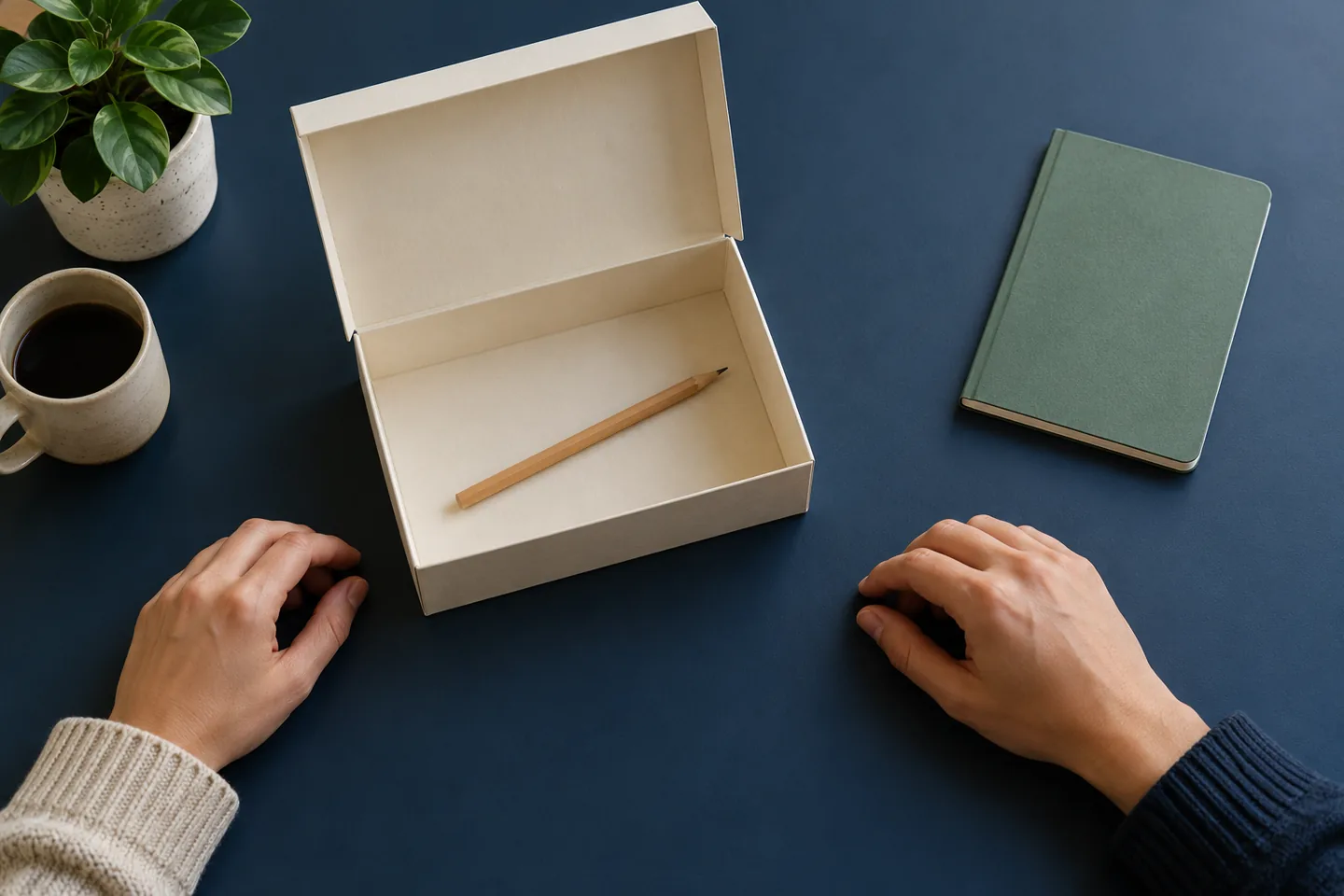
Use objects whose positions are safe to change. A closed book, empty box and wooden pencil are enough; do not hide essential keys, move someone else’s belongings or place a phone where it could fall. Make one arrangement, photograph it for your own check if useful, and describe exactly what is there. This turns a vague translation task into a small problem with an observable answer: can the listener identify the intended location?
Learn a small set of spatial contrasts
Begin with 上, うえ, for an upper position such as on or above; 下, した, for under or below; 中, なか, for inside; and 外, そと, for outside. These meanings describe relationships in context. In particular, 上 does not always mean that two surfaces physically touch. Your arrangement and the rest of the sentence tell the listener which upper relationship is relevant.
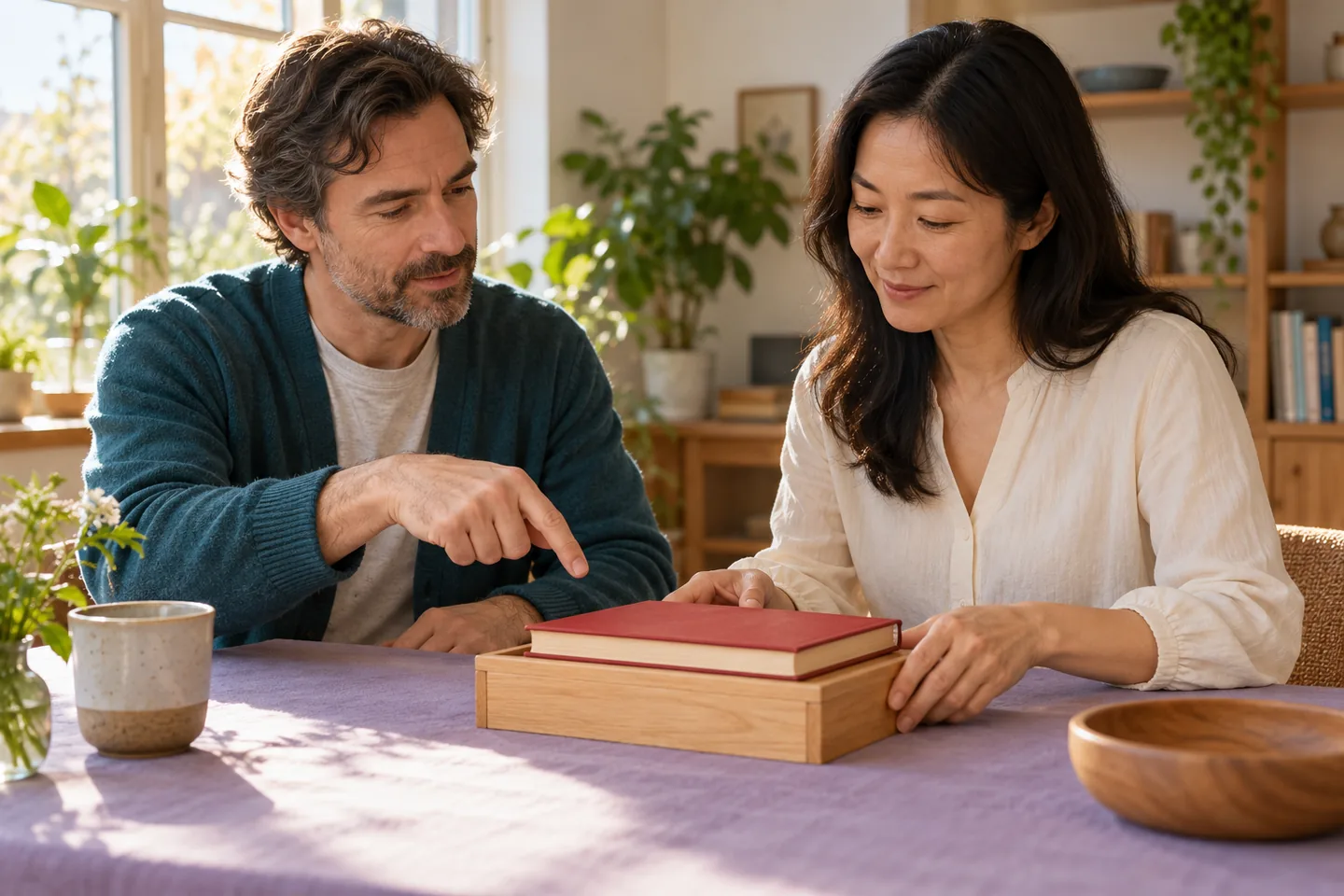
The Japan Foundation’s illustrated position sheet is useful because the words appear around objects, not only beside English translations. Compare the picture with a real box and pencil. Put the pencil inside the box, then outside it, and identify the changed relationship before looking at the label. Repeat with a book resting on a closed box and then positioned beneath it.
Keep the first contrasts visually distinct. A pencil partly crossing the rim of a box is a poor initial test of “inside” versus “outside”, because both partners may interpret the arrangement differently. Start with clear cases and discuss boundary cases later. You are learning to communicate a location, not prove that every object arrangement has only one possible description. If a picture is ambiguous, change the exercise instead of forcing certainty from an uncertain cue.
Connect the reference and position with no
A useful phrase has the order “reference object + の + position”. 箱の中, はこのなか, means “inside the box”; 箱の上, はこのうえ, means “on or above the box”; 箱の下, はこのした, means “under the box”. The reference comes before の. Say the phrase while pointing first to the box and then to the relevant region around it.
Compare 本の下, ほんのした, “under the book”, with 箱の下, “under the box”. The position stays the same but the reference changes. If you automatically search under the box after hearing 本の下, you recognised した but lost the noun that makes it useful. Practise changing just the reference rather than adding several new position words at once.
Do not swap the target and reference casually. “The book is under the box” and “the box is under the book” describe different arrangements. Draw two simple outlines to make the contrast visible. If an unfamiliar noun blocks the exercise, check its reading and meaning, then return to the full location phrase. The grammar link here can help with the connection, while a word lookup alone cannot decide which object you intended as the reference.

Place the phrase inside one checked sentence
For the inanimate objects in this exercise, use a checked model with あります. 箱の中に鉛筆があります, はこのなかにえんぴつがあります, means “There is a pencil inside the box.” The complete location phrase comes before に. The pencil is what the sentence locates, and 箱の中 identifies where it is. Keep those roles visible on your paper during the first round.
Japan Society’s location lesson demonstrates the same kind of construction with objects on a box, on a chair and beneath a book. Use that as a structural reference, then compare your own arrangement with the sentence you produce. You do not need to turn this into a complete lesson on every use of あります and います; today’s task is the spatial relationship between ordinary objects.
A question can give the exercise a clear purpose. 本はどこですか, ほんはどこですか, asks “Where is the book?” With a book on a box, a full checked answer is 本は箱の上にあります, ほんははこのうえにあります. Say the complete answer first. Shorter replies can work when the context is shared, but keeping the reference explicit makes it easier to check what you actually understood rather than rely on a pointing gesture alone.
Treat front and behind as perspective questions
Add 前, まえ, “in front”, and 後ろ, うしろ, “behind”, only after the first contrasts are clear. These introduce a practical issue: what counts as the front? A chair has a recognisable front, while a plain closed box may not. Decide what the reference means in your exercise before expecting a partner to choose the same region.
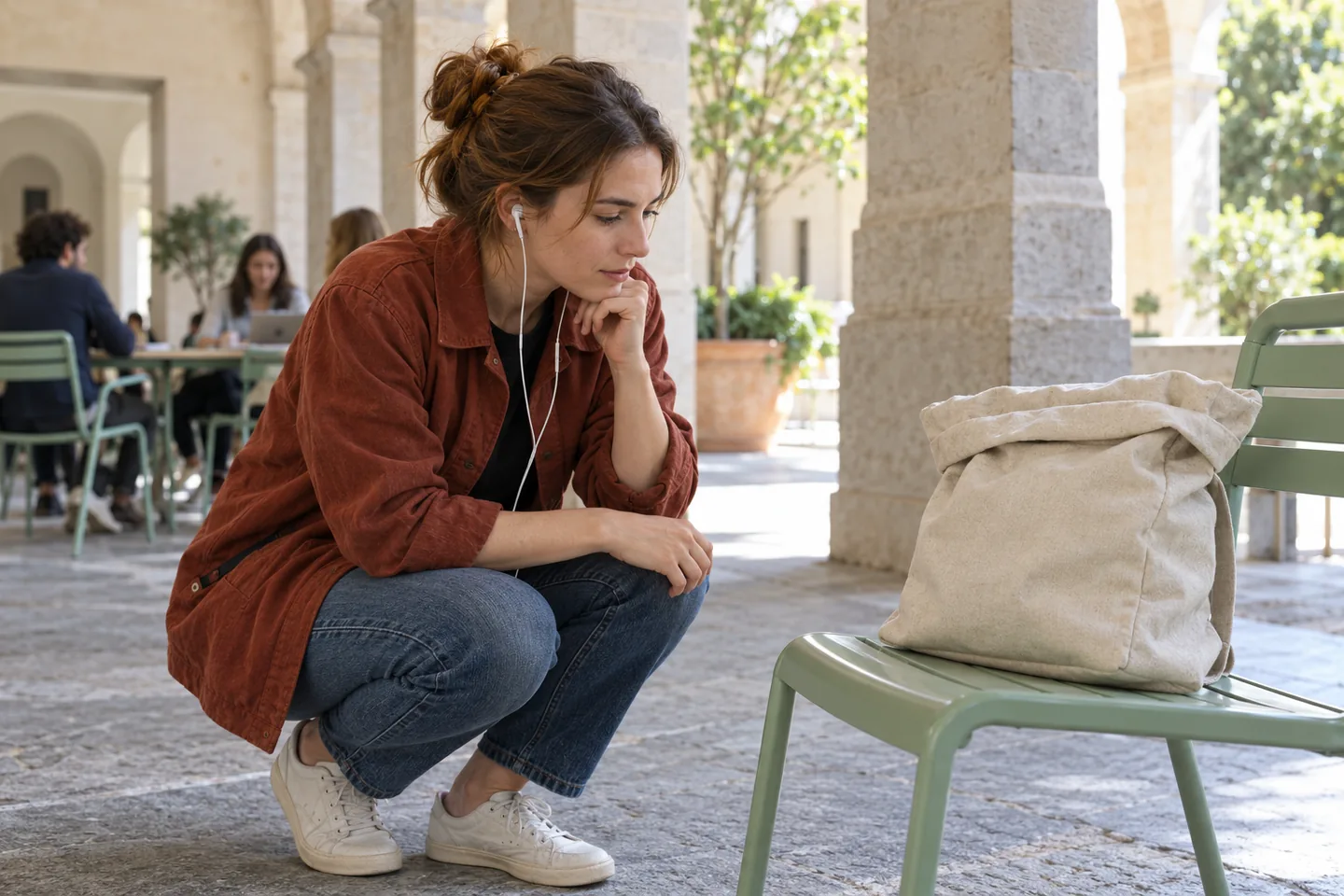
For example, use a chair facing one agreed direction and draw its orientation on your paper. Place a bag behind it, then move the bag in front. Describe the changed relationship while the chair stays fixed. If you move around the chair, discuss whether you are describing the chair’s own front or a viewpoint-dependent region. Do not assume that changing your standing position automatically changes the intended reference.
This is also why a flat photo can be an incomplete cue. Something hidden behind another object may be invisible, and a drawing without orientation can leave front and back unclear. Ask for clarification rather than guessing a position word. You can practise alone by making two sketches with a visible chair back and checking each against the actual arrangement. Learning the word and establishing the shared viewpoint are separate tasks; both are necessary for a useful description.
Let a listener locate the object from the words
Create a small information gap. Set up a box and two safe objects, then describe one position while your partner looks away from your arrangement. They can draw what they understood or choose between two pictures. Reveal the setup afterwards. A correct-looking nod is less informative than a drawing that shows which object they treated as the reference.
Begin with one complete sentence and allow a pause. Do not point during the first attempt, because a helpful gesture can conceal an unclear phrase. If the partner chooses the wrong region, compare the target, reference and position separately. You may find that both people knew the vocabulary but attached it to different objects, which requires a different correction from learning a new word.
For solo practice, make two photos or sketches with the same objects in different positions. Speak a sentence, wait briefly and choose the matching picture before checking the reference. If you use an audio source, choose one with a reliable transcript and listen for the reference noun as well as the position word. The listening guide linked here offers a wider routine when recognising those words in connected speech is harder than constructing the sentence yourself.
Repair the relationship before adding vocabulary
After an error, identify what actually failed. Was the target object confused with the reference? Did you hear 上 instead of 下? Was the location phrase missing its connection? Or did the arrangement itself make the intended region uncertain? These questions lead to different repairs. Adding five new spatial words will not fix a reversed relationship between words you already know.
Check one uncertain word in a dictionary, including its reading in this particular use. Then reconstruct the complete phrase with the real objects visible. If the problem was 本の下 versus 箱の下, keep した unchanged and practise only the reference contrast. If the problem was inside versus outside, keep the box fixed and move the pencil clearly across that boundary before trying again.
Write a short correction note with the arrangement, your attempt and the checked phrase. Explain the changed relationship in ordinary language. At the next session, hide the answer and rebuild the phrase from the picture. That checks whether you can retrieve the correct relation, rather than merely recognise a familiar sentence. Retain one successful contrast and one unresolved question; there is no need to turn a single error into a complete restart of your Japanese study plan.
Use a short mixed round to check real understanding
Set up four clear arrangements: a pencil inside a box, a book on it, a bag beneath a table and an object behind an oriented chair. Use the reference sheet to verify the words and a checked model to verify each sentence. In the first round, describe them with help visible. In the next, mix the pictures and keep the answers covered until after your attempt.
Change just one feature for a final check. Move the book under the box, or replace the box with another unmistakable reference. Before speaking, identify what changed and what stayed the same. Avoid relying on a memorised sequence in which the second card always means “under”. The aim is to recover the relationship from the arrangement, even when its order in the practice pile changes.
Finish with a practical test: could another person find the object from your words without seeing you point? If not, decide whether the missing piece is the reference, the position word or the sentence connection. Keep that specific question for the next session. A small set of clear, checked location phrases is enough to begin describing your surroundings; a longer list becomes useful when it adds a distinction you can actually recognise and communicate.