

Japanese reported speech becomes difficult when the words travel further than the original conversation. You hear a short message, tell someone else and suddenly cannot tell whether “I” means you or the person who spoke. The grammar may be familiar, yet the listener still assigns the plan to the wrong person. Start by keeping the speaker, the message and your act of reporting separate.
This guide uses fictional notes and a three-person message exercise. You will quote a short statement, report its content and check what another listener understood. Paper cards and a reference are enough; the practice does not depend on an app. Keep the vocabulary small so that you can concentrate on whose words you are carrying. Your aim is an accurately attributed message, not a longer sentence or a claim that the original statement must be true.
Give Japanese reported speech a clear frame
The useful starting frame is a message followed by と and a verb of saying. In リナさんは「行きます」と言いました (リナさんは「いきます」といいました), Rina said, “I will go.” The surrounding context establishes where she intends to go. The bracketed words belong to her utterance; 言いました describes the act of saying them. Do not merge those two layers into a claim that Rina has already made the journey.
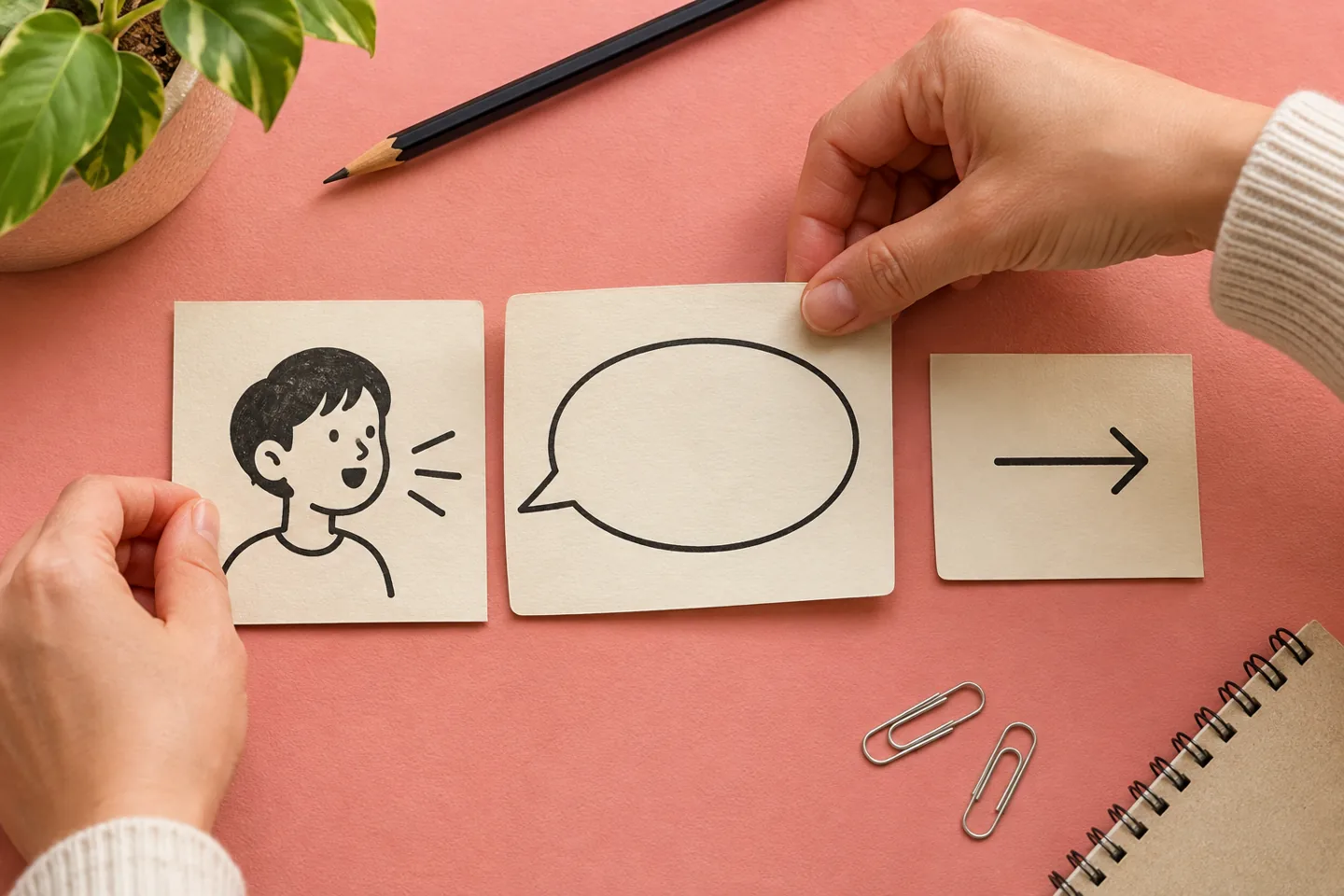
Draw three boxes labelled speaker, message and report. Put Rina in the first, 行きます in the second and your account of what she said in the third. Read the Japanese sentence while pointing to the boxes. Your listener should identify Rina as the original speaker even though you are the person speaking now. If they think the plan is yours, make the attribution clear before adding more information to the message.
For the first round, keep the name visible on a card and say it each time. Real conversation often leaves information understood from context, but this exercise gives you a way to inspect the reference. Once your partner consistently assigns the words to the intended person, try a short exchange in which the name is already established. Remove the support because the context supplies it, rather than because you have forgotten to track the speaker.
Quote words without rewriting their voice
A direct quotation presents the wording you are quoting. If the original fictional note says 行きます, keep 行きます inside 「」 when you reproduce those words. You can still put a polite reporting verb outside the quotation. The form inside and the form outside serve different parts of the sentence. Quotation marks make that boundary visible on paper; they are not words that you pronounce as part of the Japanese message.
Cambridge's lesson on quoting and reporting explains the role of と in both direct and indirect speech. Use the direct version first when you want to preserve the note's wording. Place a copy of the original beside your quotation and compare them before practising aloud. That comparison checks your accuracy as a reporter. It does not tell you whether the person will actually carry out the plan they described.
Make one deliberate change to your copied note, then ask a partner to find it. Perhaps you removed the polite ending or changed a positive statement to a negative one. Restore the original before reading the quotation. This small editing task reveals why copying the message and retelling its content are different jobs. You can practise both, but you need to know which job you are attempting on each turn.
Use plain forms when reporting the content
For a basic indirect report of a statement, use a plain form before と. 行きます becomes 行く in 行くと言っていました (いくといっていました), “was saying that they would go,” with the person established by context. The reporting phrase can remain polite. Plain wording inside the reported clause does not require the whole conversation to become casual. The Japanese grammar overview can help you review plain forms before you build a longer report.
Check the type of predicate rather than applying one replacement everywhere. 忙しいです (いそがしいです, “I am busy” in our note) gives 忙しい before と. 学生です (がくせいです, “I am a student”) gives 学生だ. Thus リナさんは忙しいと言っていました reports that Rina was saying she was busy; リナさんは学生だと言っていました reports her statement that she was a student. Do not add だ after the i-adjective 忙しい.
Keep three separate cards for the verb, the i-adjective and the noun. Cover the examples and reconstruct the reported clause from each note. Then check the predicate ending before reading the whole sentence. This is a limited set of ordinary statements. Questions, requests and commands need their own treatment; a successful result here is not a rule for mechanically converting every kind of utterance you encounter.
Attribute a statement without turning it into proof
A report tells your listener that a person said something. It does not, by itself, verify the content. In a message exercise, keep a speaker card beside every statement. If Rina says she is a student, your task is to pass on her statement accurately. You do not need to invent a school, a qualification or a reason for believing her. Leave details absent when the source note did not provide them.
Use the Japanese dictionary to check a word such as 言う (いう, to say) or 学生 (がくせい, student) when its reading or meaning is uncertain. A vocabulary repair is different from adding an interpretation. Write a small question mark beside information you did not understand. Ask for clarification before you replace it with a plausible guess. The resulting report may be shorter, but its relationship to the original message will be clearer.
Try two notes from different fictional people. One says 行きます and the other says 行きません. Shuffle them while keeping each name attached. Ask your partner who said they would go and who said they would not. When an answer is wrong, check the person-message pairing before drilling the verb again. A perfectly formed negative sentence is still an inaccurate report if you assign it to the wrong speaker.

Keep the original viewpoint in sight
Inside a direct quotation, a word such as 私 (わたし, I) belongs to the quoted speaker's viewpoint. When you read someone else's words aloud, it does not automatically refer to you as the present narrator. Draw an arrow from 私 in the note to the original speaker card. Then read the quotation and ask your partner whose plan or situation is being described. This visual support makes an otherwise hidden reference easy to check.
Time and place words also need context. A quoted 明日 (あした, tomorrow) is understood from the original utterance situation. If you pass the message on later, your listener may need an explicit date to know which day was meant. Keep the original note and record when it was spoken. Do not automatically replace every occurrence of tomorrow with the same expression regardless of when you are reporting it.
For this exercise, keep the indirect version simple by naming the person and omitting an unnecessary pronoun when the reference is clear. If two people could fit the same omitted subject, clarify the person in the surrounding exchange. There is no prize for making the message shorter at the cost of understanding. Ask the listener to paraphrase who will do what before you decide that the reference is sufficiently clear.
Listen beyond the quoted content
When you hear 行く, wait for the rest of the sentence. 行くと言っていました reports someone's words; it does not have the same function as a speaker simply announcing their own plan. Listen for と and the reporting expression that follows it. The Japanese listening practice guide describes ways to give a short recording a specific task. Here your task is to separate the message from the frame that tells you whose statement it is.
Ask a partner to read a checked model while you arrange the speaker and message cards. First identify the original speaker; then decide whether the content is positive or negative. Only after that should you write down the whole sentence. If the words inside the message were clear but the attribution was not, replay for the frame. Repeating the familiar content alone will not repair the missing link between person and statement.
Keep the time of saying separate from the time of the reported event. A past reporting expression does not mean that every event inside the message is already complete. In our plan example, someone spoke earlier about going later. Avoid changing the inner verb to a past form merely because the outer reporting expression refers to an earlier conversation. Match the forms to the intended message and check the model when you are uncertain.

Test the message with a three-person relay
Give one fictional note to the first participant. They read it to a reporter, who then tells a third person what was said. The final listener selects the speaker card and the matching message. Start with just the three statement types already practised: a plan to go, being busy and being a student. Keep the original note hidden from the last listener until they have made their selection. Otherwise, the activity can become a reading test rather than a report check.
Compare the result with the original. Was the right person named? Was the statement positive or negative? Did an added detail appear that nobody supplied? Correct one mismatch and repeat the exchange with a different note. Swap roles so that you experience both the speaker's wording and the listener's need for a clear source. A short successful relay is more informative than a long retelling that nobody checks.
Finish by keeping one direct quotation and one indirect report of the same note. Label the parts you preserved and the forms you changed. On another day, rebuild both versions from the speaker and message cards before consulting the model. You now have a usable routine: preserve the original when quoting, choose appropriate plain forms when reporting and confirm what your listener attributed to whom. If a reference remains unclear, repair that reference before expanding the story.