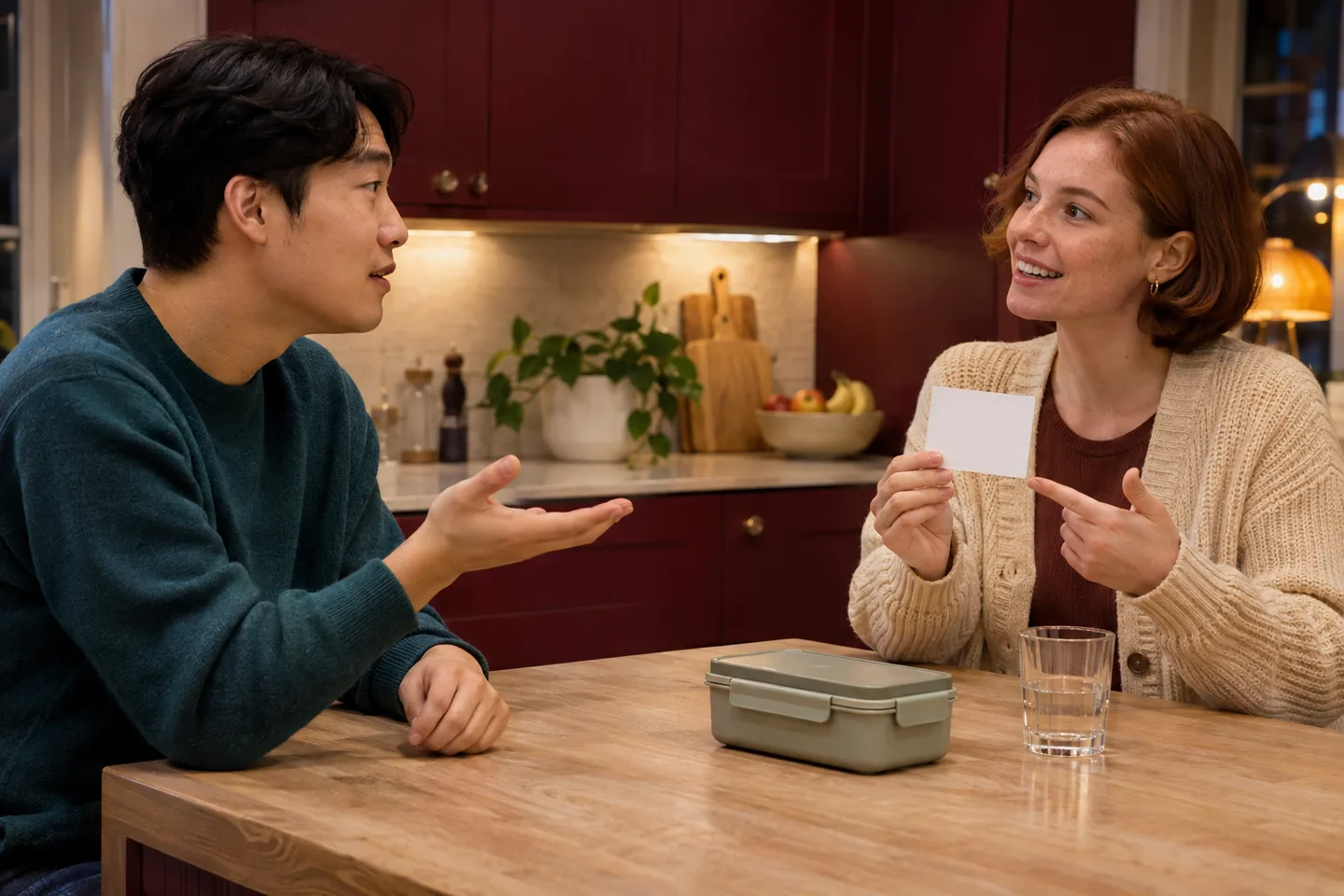

Mou and mada in Japanese can change the message of a sentence you otherwise understand. You mean “I have not eaten yet”, but choose a form that sounds like you will not eat any more. Or you see a negative ending and assume the action has stopped, although the speaker is saying it has not happened yet. The useful starting point is the situation, not a two-word translation list.
This guide uses a small meal scene to separate completion, an action still in progress and an action that remains pending. It then connects the distinction to explanation, an attempt, feedback, later review and listening in KanaWay. The Android app is available on Google Play. Keep your own scene notes on paper; this routine does not assume a dedicated mou-and-mada lesson, custom sentence imports or automatic grading of your personal examples.
Mou and mada in Japanese: decide what is true now
Before choosing a Japanese sentence, draw a small scene and identify the moment you are discussing. Has the relevant meal already happened? Has the person not eaten yet? Are they still eating? These are different messages even though the same person, plate and verb can appear in all three. Write the intended situation in ordinary English before consulting the Japanese model.
Use fictional details so the exercise stays about language. A closed lunchbox can represent a pending meal; an empty plate can represent one already eaten. These objects are practice cues, not reliable evidence about a real person's eating. In an actual conversation, ask rather than infer someone's circumstances from a photograph or plate. The exercise needs a shared scenario, not a rule about people.
Keep one viewpoint for the first round: the moment of this conversation. Do not add a story about yesterday before the basic contrast is clear. Ask yourself which fact the listener should learn after your answer. If your meaning cue is vague, correcting the Japanese ending alone will not solve the task. A precise cue makes the later feedback useful because you can compare the sentence with what you intended.
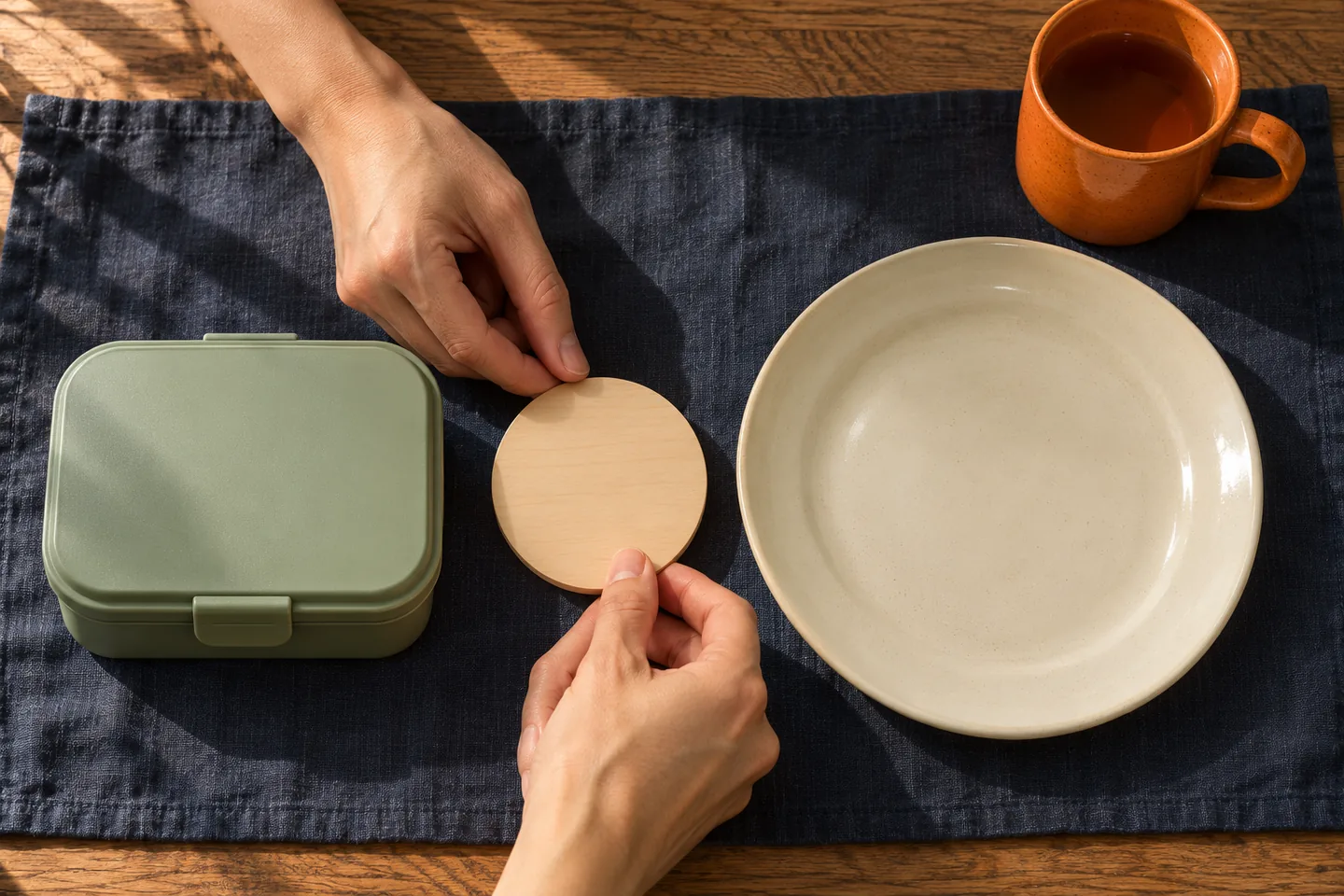
Use mou with a completed action in this model
もう食べました, もうたべました, means “I have already eaten” in our meal scene. The action is presented as completed. Read the whole expression rather than giving もう one English equivalent and ignoring the verb. 食べました is the polite past form used here; it is part of the model you are checking, not optional decoration around a vocabulary item.
The Japan Foundation's Irodori grammar notes present もう with a completed-action sentence and contrast it with a pending action. Consult that explanation beside your first attempt, then close it. Do not treat this short model as a universal claim about every use of もう. Expressions involving an additional quantity have another job. You can leave those aside until you need them in a verified context.
Make two versions of the fictional scene: one before the meal and one after it. Choose the completed-action sentence only for the second. Say what the listener should understand, then compare the model with your attempt. If you selected もう because it was the last word you studied, shuffle the scenes and try again. Meaning should determine the choice; a fixed card order should not do the work for you.
Make not yet different from still doing something
まだ食べていません, まだたべていません, means “I have not eaten yet” in this scene. The meal remains pending at the moment being discussed. Keep the complete negative expression together when you check your attempt. Simply adding まだ to whichever past sentence you remember does not preserve the same message. For this first routine, use the checked polite model rather than inventing a shortcut from English.
Now compare まだ食べています, まだたべています, “I am still eating”. Here the action is continuing. The difference between います and いません matters: it changes what is happening in the scene. Do not learn まだ as if it always meant “not yet” by itself. The rest of the expression helps determine whether you are describing continuation or something that has not happened.
Cover the Japanese and choose between a person with an unopened lunchbox and a person partway through a meal. Say the intended meaning first, produce the complete model and check the ending. If both pictures trigger the same response, slow down. You need a meaning distinction, not a longer vocabulary list. Keep the cues unambiguous and change the order only after you can explain why the other response would misdescribe the scene.

Answer the question without replacing pending with refusal
もう食べましたか, もうたべましたか, asks whether the relevant meal has already happened. In the shared scene, はい、もう食べました, はい、もうたべました, confirms that it has. いいえ、まだです, いいえ、まだです, is a short “No, not yet”. The brief answer works because both people know what action is under discussion. Without that shared context, make the question clearer before relying on a reduced reply.
Do not substitute もう食べません, もうたべません, for the pending-meal answer. In a context where you decline further food, it can communicate “I will not eat any more”. That is different from saying the meal has not happened yet. Keep this contrast tied to the situation; it is not a reason to assign one permanent translation to every possible negative sentence with もう.
Practise a short exchange with a partner or read both roles from checked notes. One person chooses a fictional state privately, the other asks the question, and the reply must match that state. Afterwards, say what would happen next in the scene. Is eating still pending, already complete or continuing? If the reply accidentally communicated refusal, return to the full not-yet model before shortening the answer again.
Start an app-assisted attempt from one meaning cue
In KanaWay's grammar and practice path, begin with an available explanation and examples that actually address the contrast you need. If the material does not contain this exact pattern, use the verified reference for the pattern and the app for relevant vocabulary or listening. A broad grammar label does not prove a dedicated activity exists. Keep the task small enough that you can inspect the language you are practising.
Read a complete model, hide its answer where the activity allows an independent attempt, and decide what you want to communicate before responding. Your paper cue might say “the meal has not happened at this point”. It should not display まだ or the entire ending in advance. Otherwise, you may copy a form while believing you recalled the relationship between the situation and the sentence.
After answering, compare meaning and form separately. Did you select the correct situation? Did you retain the relevant verb expression? Did you answer the actual question? Use the feedback attached to the activity for that activity; do not assume the app has diagnosed your personal error category. Write your own brief observation beside the cue. This makes the next attempt a focused test rather than another pass through the same visible answer.
Repair the part that changed the message
A useful correction identifies the smallest meaningful mismatch. If you chose “already” for a pending meal, revisit the scene choice. If you chose the right scene but lost the negative ending, compare the full positive and negative expressions. If the verb itself was uncertain, check the dictionary form, reading and meaning before returning to the sentence. Different errors require different repairs, even when both answers were marked wrong.
Use KanaWay's described dictionary and grammar areas for the specific uncertainty they can resolve. A word lookup can establish that 食べる, たべる, means to eat; it does not alone explain what the entire reply communicates in your conversation. A grammar explanation can connect the form with the situation. After looking up the missing piece, return to your original cue instead of browsing many unrelated entries.
Make one changed attempt after correction. Reverse the state, keep the person and action familiar, and produce the other checked response without leaving the solution visible. Do not change the verb, time viewpoint and conversational purpose together. Too many changes make it difficult to tell whether the original confusion improved. Keep the comparison honest: understanding the correction is useful, but producing a suitable response later is a separate task.
Use review and listening to retrieve the distinction again
Review material you actually studied rather than saving every unfamiliar expression. KanaWay's vocabulary and review path can provide later encounters with useful words; keep the full situation cue in your notebook if that is where you created it. Saving a dictionary item does not mean the app automatically saves your custom scene, comparison table or explanation of an error. Use the controls and content the available activity genuinely provides.
For listening, take a short reliable recording with a matching transcript. First decide whether the action is completed, pending or continuing; then check the words and ending that support your interpretation. Tokyo University of Foreign Studies illustrates an ongoing action with the ています pattern. That helps you keep the continuing-meal model separate from the not-yet model, without turning every ている expression into a promise of one English tense.
Use a relevant listening activity in KanaWay when it contains a suitable example, or keep the published recording with its own transcript. Never rewrite the transcript and pretend the unchanged audio models the new sentence. Replay only the uncertain part, check it and make a fresh listening attempt. A typed answer or correct grammar exercise is useful evidence for that task, but it does not certify that you understood a different speaker in a new exchange.

Return later with a changed scene and a clear next step
At a later session, mix three fictional state cues and leave the Japanese models covered. Say what each scene means, produce a suitable sentence and explain the difference from the neighbouring choice. Add a short question-and-answer exchange only when the basic contrast is stable. The aim is a coherent message, not finishing a prescribed number of cards or achieving a score that promises conversational mastery.
Keep a compact record: intended state, attempted expression, verified correction and one later check. If you confuse pending and continuing, return to those two scenes. If the model is accurate but the reply does not answer the question, practise the exchange rather than another isolated word. If listening is the obstacle, shorten the recording. Let the observed gap choose the next task instead of restarting every part of the routine.
The complete loop is meaning cue, checked explanation, attempt, feedback, targeted repair, later review and listening or conversation. KanaWay for Android can connect relevant parts of that path, while paper preserves your personal cues. You do not need to claim an invented feature or guarantee a learning outcome. A useful result is modest and testable: you can tell the listener whether the action has already happened, is still pending or is continuing now.