Nagara in Japanese helps you describe two activities that overlap, but a sentence can look well formed and still describe the wrong scene. Perhaps one person is drawing while another listens to music. Perhaps the drawing starts only after the music ends. Both situations contain the same activities, yet neither matches the simple simultaneous pattern you meant to practise.
Begin with a seated learner who draws while listening to music. Follow the actor, check the overlap and decide which activity your sentence will present as its main message. This guide combines a short KanaWay grammar session with paper scene cards and a listening check. The cards stay outside the app, and the final test is whether someone else identifies the scene from your sentence. The pattern describes a situation; it does not promise that dividing your attention improves learning.
Use nagara in Japanese for one actor and two actions
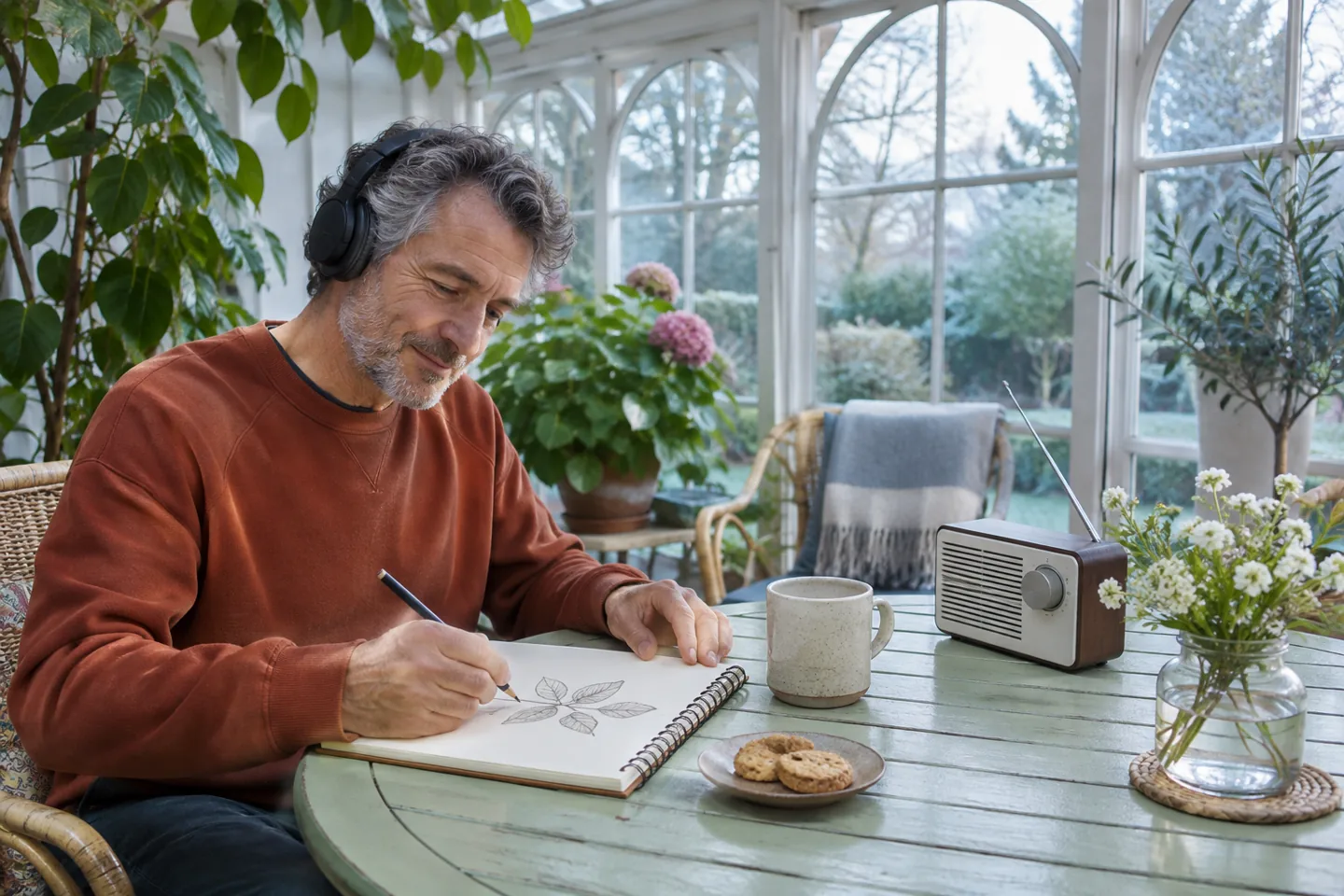
音楽を聞きながら絵を描きます (おんがくをききながらえをかきます) means “I draw while listening to music” in a context where the speaker describes their own routine. One person performs both activities, and the activities overlap. The sentence gives listening as the accompanying activity and drawing in its final clause. Start with a drawing of one person beside a radio, holding a pencil. You can point to each action before saying anything in Japanese.
St. Olaf College's Japanese grammar reference describes the verb-stem pattern and notes that the two actions must have the same performer. Use that condition as a meaning check rather than a final detail to memorise after the conjugation. If your picture has two people doing separate things, changing a verb ending will not repair the mismatch. You first need a sentence that represents the people in the scene accurately.
For the first attempt, name the actor and both actions in English. Then say the Japanese model while following that same person with your finger. Your listener should be able to answer who is drawing and who is listening without inventing a second person. Keep the scene ordinary and easy to picture. The first goal is a clear relationship between actions, not an impressive sentence with several unfamiliar words.
Attach nagara to a checked verb stem
Build the first part from the stem used before ます. 聞く (きく, to listen) gives 聞きます, so the stem is 聞き and the pattern begins 聞きながら. 読む (よむ, to read) gives 読みます and 読みながら. 食べる (たべる, to eat) gives 食べます and 食べながら. Say the polite form, remove ます and attach ながら. Do not remove an arbitrary final syllable from the dictionary form and hope the result will work.
Use the Japanese dictionary when you do not know a verb's reading or group. In particular, a familiar written ending does not identify every verb's conjugation by itself. For this session, keep a tiny reference with 聞く, 読む and 食べる. The purpose is to connect a verb you understand to its stem. A larger list would make it harder to see whether a mistake comes from the word, the polite form or the attachment.
Try each step without looking, then compare it with your reference. If 聞きます was correct but you wrote 聞きますながら, you kept the polite ending where only the stem belongs. If the polite form itself was wrong, return to that step first. Mark the exact boundary on your card. This gives the next attempt a specific target and lets you recognise improvement without merely remembering the answer's visual shape.
Choose what the final clause will tell the listener
The final clause carries the sentence's main activity. In our model, the answer is about drawing, with music as an accompanying activity. Ask yourself what your partner wanted to know. If they asked about your drawing routine, ending with 絵を描きます (えをかきます) makes that activity clear. Do not decide the order just by putting the action you remembered first at the start of the sentence.
Use two blank cards, one with a pencil sketch and one with a radio sketch. Put the accompanying activity on the left and the main message on the right. Read the full sentence, then cover the left card and say what remains. You should still have a useful statement about the main activity. This is a planning aid for the exercise, not a claim that the other activity is unimportant to the person doing it.
Now change the question rather than mechanically reversing every sentence. A new question may call for a different emphasis or a different expression altogether. First explain the intended answer in ordinary language, then choose a natural Japanese model. Keeping this step separate prevents a successful conjugation drill from becoming a rule that any two verbs can always be swapped without affecting the message.
Check overlap before choosing the connector
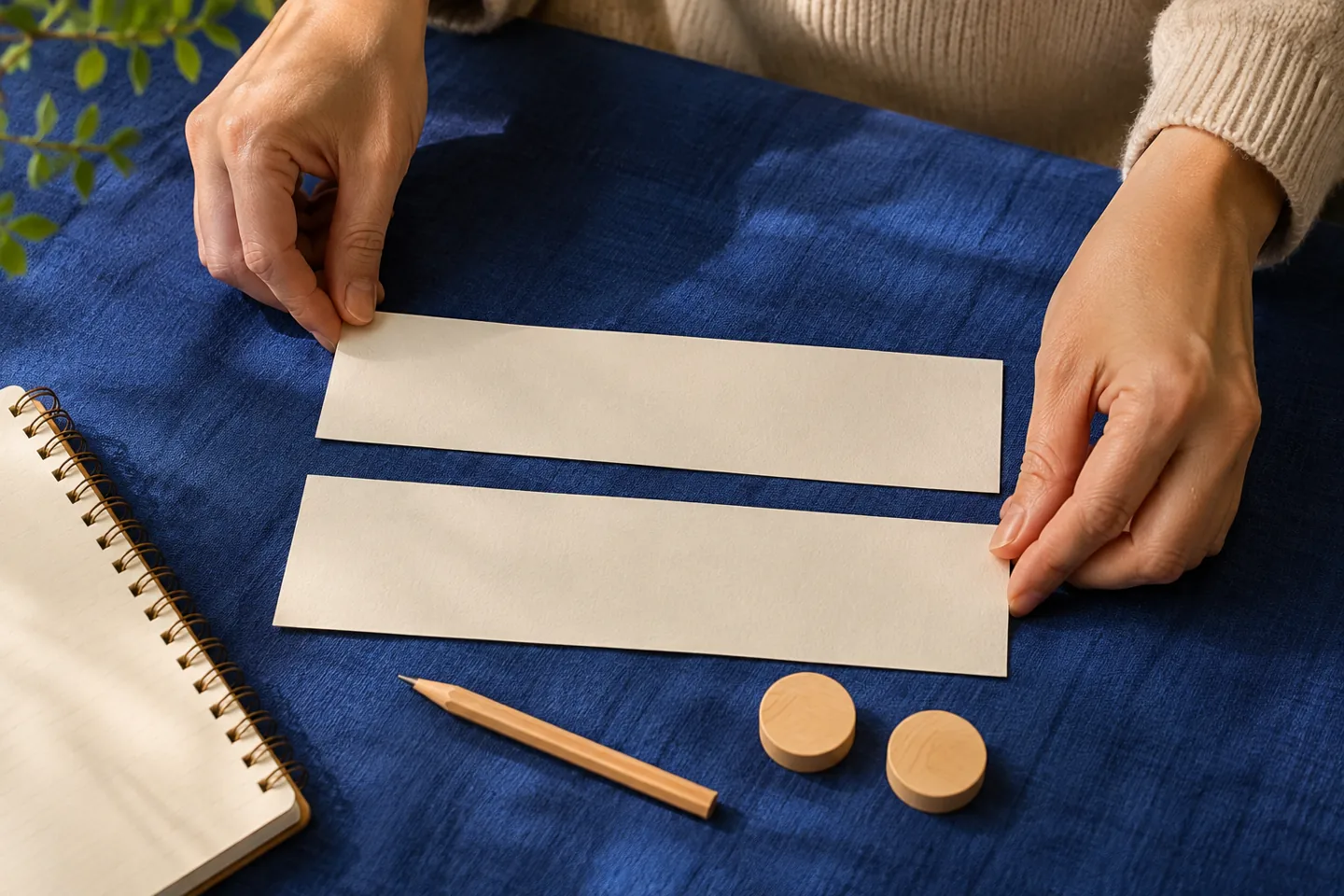
Place two strips on paper to represent the activities. If listening and drawing occur together, let the strips overlap. If the music ends before drawing begins, place them one after the other. The pictures may contain identical objects, but the time relationship differs. Use ながら for the overlapping scene in this exercise. For the sequential scene, describe the actions separately while you check a suitable way to express their order.
The Cambridge lesson on ながら explains that the activities must be separate actions performed by the same person and may be simultaneous or concurrent. This guide starts with a short, visible overlap because it is easier to verify. That does not mean every use of ながら must describe two movements happening in exactly the same second. Longer concurrent activities need their own context, which you can study after the basic scene is clear.
Make a second picture with one person listening and another drawing. Leave your verb cards unchanged and ask whether the simple model still fits. It does not express that two-person arrangement. Explain the scene using two short statements instead of forcing ながら into it. This small rejection task is valuable: knowing when your model does not fit shows more understanding than applying it successfully to the only picture you have practised.

Use KanaWay to repair the form, then return to the scene
In KanaWay for Android, open a grammar explanation or exercise involving a familiar verb. Predict the required form before checking the answer. Read the feedback and identify the part that needs repair. You might need the verb's polite form before building your own ながら phrase. The scene cards provide your personal example outside the app; this routine does not depend on importing a picture or receiving an automatic judgement on a sentence you invented.
After the exercise, close the answer and rebuild 聞きながら from 聞きます on paper. Then add 絵を描きます and return to the actor and overlap checks. The Japanese grammar overview can help you choose a suitable reference when the issue is a form you have not yet learned. Keep meaning and construction in the same short session so that a correct ending does not conceal a scene with two different actors.
Write one review note: “stem”, “actor” or “overlap”, followed by the correction you actually needed. At the next session, attempt that step before rereading the note. If it works, change one part of the scene and try again. This gives review a reason beyond repeating yesterday's sentence. The app exercise checks its own task; your separate scene exercise checks whether you can use the form to describe a new situation.
Listen through the final verb and its tense
Compare 音楽を聞きながら絵を描きます with 昨日は音楽を聞きながら絵を描きました (きのうはおんがくをききながらえをかきました), “Yesterday I drew while listening to music.” The first can describe a routine in an appropriate context; the second reports a past occasion. The ながら part remains unchanged. Listen to the whole ending before deciding when the scene takes place. Recognising 聞きながら alone does not tell you the tense of the complete sentence.
Ask a partner to read a checked model while you choose between a routine card and a yesterday card. Identify the main activity as well. The Japanese listening practice guide suggests ways to give a short recording a clear task. Here there are two manageable questions: which activity is the sentence about, and is it a routine or a past report? Compare answers before trying to transcribe every word.
If you need another listen, decide which question is still open. Focus on the final verb when the time is uncertain. Focus on the action word after ながら when the main activity is missing. Once you have checked the answer, repeat the complete sentence and show the matching scene. Avoid treating more intense concentration as the only solution; a specific listening target gives you a result you can actually evaluate.

Finish with a scene your partner can recognise
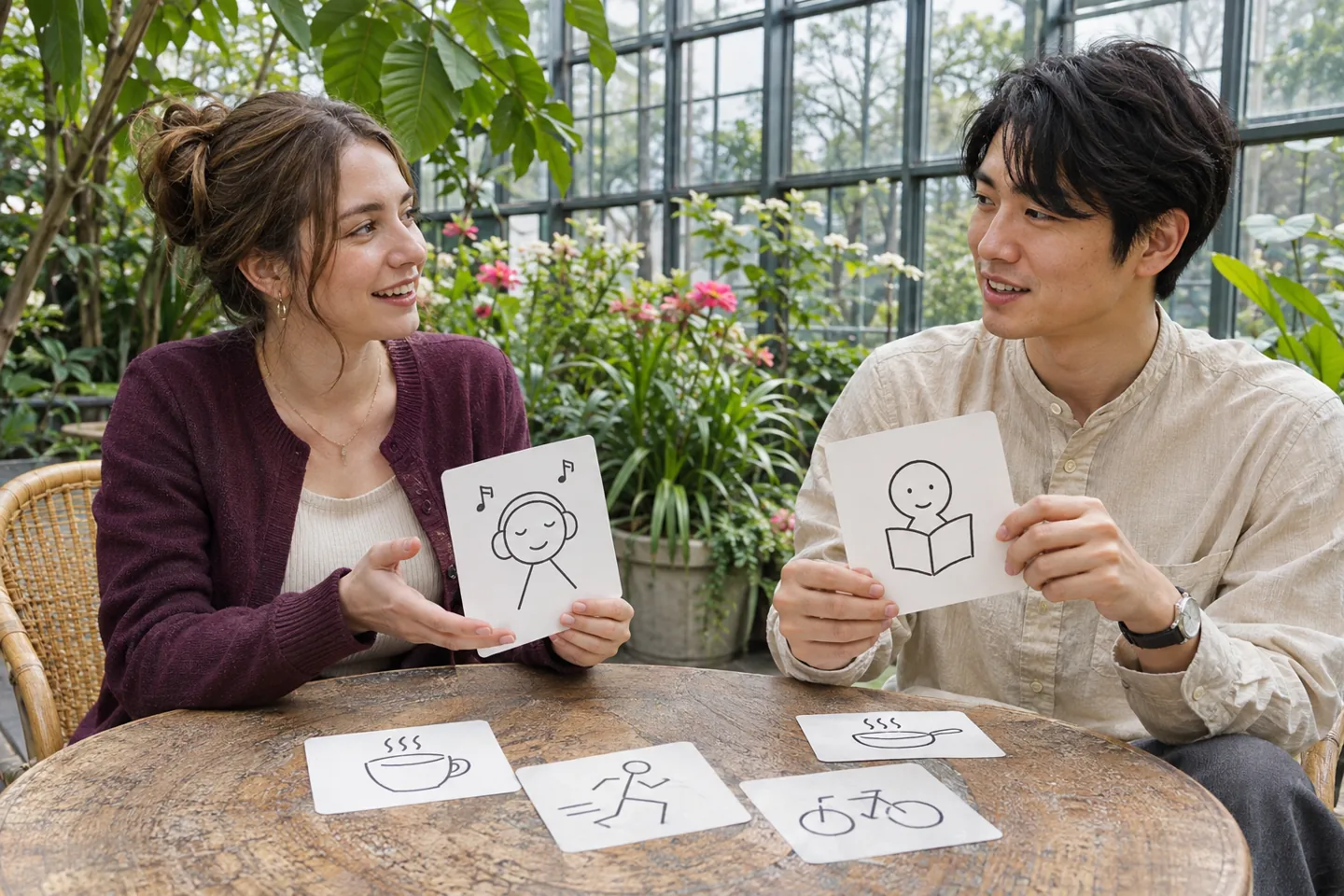
Choose three cards: one person doing overlapping actions, the same person doing them in sequence, and two people each doing one action. Keep the objects similar so that the relationship, rather than a striking prop, determines the answer. Describe the overlapping scene with your checked ながら model. Your partner selects a card and explains their choice. If the chosen picture differs from your intention, compare the actor and timing before changing any Japanese sounds.
Then swap roles. Ask your partner to use a verb you both understand and a scene that can be explained simply. You can consult a reference between attempts, but make the actual selection without looking at its answer. A short pause to rebuild a stem is useful information about what to review. It does not require you to abandon the whole exercise or add several new grammar patterns at once.
For your final note, keep the model, the scene it describes and one contrasting scene where it does not fit. On another day, retrieve the sentence from the scene before reading the model. You now have a small practice cycle: understand the relationship, build the stem, complete the message and check what a listener understood. The result is a usable description of overlapping actions, with a clear next step whenever one part still needs attention.