
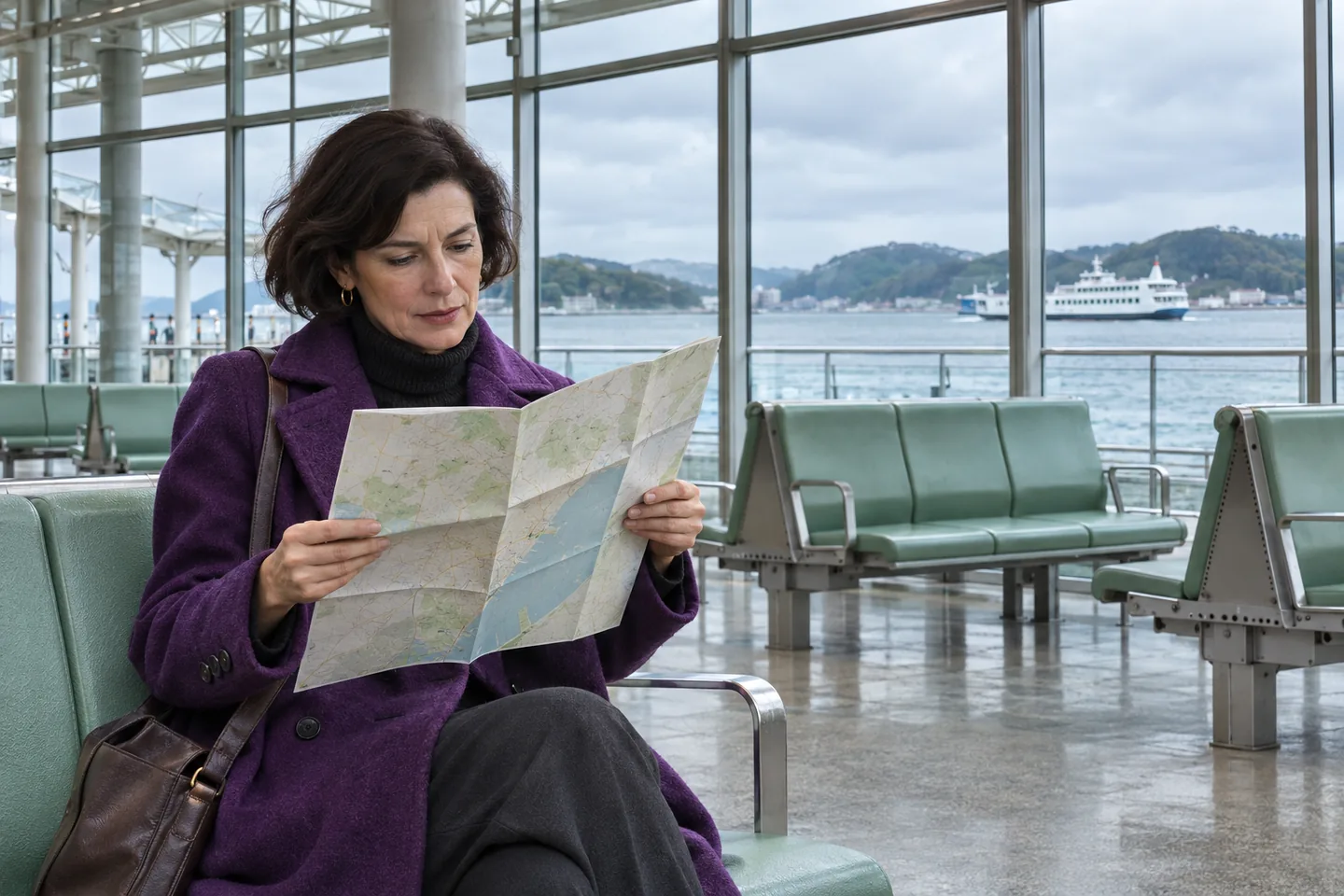
Tara vs nara in Japanese matters when someone needs to know what to do before leaving and what to do after arriving. Imagine telling a friend to check the departure time for a ferry. A sentence that makes arrival the trigger would place the check too late. A sentence that treats the planned journey as a premise lets you offer advice before the journey begins.
This guide uses two short messages and a few pieces of paper. You will first mark when each action belongs, then build the Japanese from checked examples. You can finish the whole practice with a notebook or a partner. The aim is to make your meaning clear enough that the other person can put the actions in the right order.
Tara vs nara in Japanese on a two-card timeline
Write “arrive at the port” on one card and “call me” on another. Imagine you want the person to call once they are at the port. Put arrival first. The call depends on the person reaching that point. You could draw an arrow from the first card to the second, or leave the second card face down until you touch the first. The physical action helps you keep the relationship visible while you work on the Japanese.
Now put “take the ferry” at the top of the page. It is a proposed plan. Under it write “check the departure time before leaving.” The check comes before the ferry ride even though you mention the ferry first. The order of the clauses on the page and the order of events in the world are two different things. A listener should know which one you mean.
In your own notes, describe the two purposes without any grammar labels. One message tells the person when to call. The other tells the person how to prepare for a plan. If you can explain those purposes, you have enough information to choose a model. Keep the labels beside your examples until the choice becomes easier.

Make arrival the trigger with たら
港に着いたら、電話してください (みなとについたら、でんわしてください) means “Please call when you arrive at the port.” The arrival establishes the moment when the request applies. Imagine the person still travelling toward the port. They can read your message now and know that the call belongs after arrival. The form does useful work here because it links the request to an identifiable event.
Start from 着く (つく, to arrive). Its plain past form is 着いた (ついた). Add ら to get 着いたら (ついたら). The Tokyo University of Foreign Studies grammar module describes this formation from the plain past form. In the request above the arrival is still ahead, so the form used to build 着いたら does not tell you the arrival already happened. Interpret time with the entire sentence and situation.
Write only the first clause, then ask yourself what the other person can do with it. They know the condition and still need the requested action. Add 電話してください to complete the message. Next cover the Japanese and read your two cards again. If the call comes out first in your paraphrase, correct the event order before you worry about recalling every character. Keep the Japanese sentence complete when you check.
Use なら to respond to a plan
フェリーで行くなら、出発前に時刻を確認してください (フェリーでいくなら、しゅっぱつまえにじこくをかくにんしてください) means “If you're going by ferry, please check the departure time before you leave.” The trip is the premise for the advice. The expression 出発前に tells you that the check belongs before departure. You could say this as a reply after your friend tells you which transport they are considering.
Look at 行くなら (いくなら). In this example the plain nonpast form 行く comes before なら. On a separate line, write the topic your friend mentioned and what you want to recommend. You should be able to say why the advice makes sense under that premise. If they change their plan, you can reconsider the advice. This is a useful conversation cue when you hear なら.
An account of Japanese conditionals from the Society for Teaching Japanese as a Foreign Language also discusses how the action in a なら sentence can come before the event named in the condition. The sentence itself gives you the relevant timing here. Do a quick check by pointing to the words that say “before departure.” That check keeps you from building a new oversimplification in which every なら sentence is about a preparation step.

Build two forms without guessing from the last syllable
Try 行く (いく, to go) on paper. Write 行った (いった), then 行ったら (いったら). Compare it with 行くなら (いくなら). Read the whole pair aloud. In your own practice, mark the base and what you added. If you are unsure how a verb makes its plain past, check that form first. You can save yourself a second error by verifying the base before adding the conditional ending.
Repeat the same exercise with 読む (よむ, to read). The plain past is 読んだ (よんだ), and adding ら gives 読んだら (よんだら). The other form is 読むなら (よむなら). This example lets you see why the form called tara sometimes appears as だら at the end of a verb. Do not replace the だ of 読んだ with た. Use the past form that belongs to the verb.
Before building longer sentences, test both pairs with two separate prompts. On the first card write “give the form based on the plain past.” On the second write “give the form used in today's premise model.” Shuffle the cards. After a correct answer, tell yourself which job the form can do in the examples you have just learned. That keeps conjugation practice connected to meaning.
Change one part of the scene and test your message
Use the port arrival and the call as your first practice round. Suppose the person needs to send a message instead. Keep the time relation the same and try 港に着いたら、連絡してください (みなとについたら、れんらくしてください), “Please get in touch when you arrive at the port.” The contact method is open in this sentence. The arrival still sets the time for getting in touch.
For a second round, go back to the ferry plan and the instruction to check before departure. Keep the original sentence and change the situation around it. Imagine the traveller already has a timetable but has not checked the relevant time. Then imagine they are still deciding which route to take. The advice can fit both scenes if the ferry remains the premise. Decide whether you need a new sentence or simply a new note about the context.
Finally, try explaining the message in your own language without copying the wording of the translation. A good paraphrase identifies the person, the action and when it applies. If it leaves the timing vague, point to the Japanese clause or the time expression that supplies it. Give yourself credit for understanding the relationship even if you need another look at a reading.
Practise a short exchange with an independent check
One person reads the travel plan or the arrival request. The other arranges the cards and says what they would do. For the arrival request, the expected answer is to reach the port and then make contact. For the ferry advice, the expected answer is to check the time before setting out if travelling by ferry. Switch roles after each round and ask the new listener to show their interpretation before you explain the answer.
If you are working alone, write your reply on the back of each card and put the cards in a random order. Read the Japanese, move the time cards and then check the reply. You can also read the sentence aloud and listen to your own recording once. Use the written model to confirm the words and readings. Your recording is a recall check; for hearing another speaker, choose a recording with a matching transcript.
A mistake gives you a choice of what to practise next. If the order was wrong, draw the events again. If the order was clear but the form came out wrong, rehearse only the verb pair. If you understood the words individually and missed the premise, put the preceding line of dialogue back into the example. Each correction should address the uncertainty you actually noticed.

Return to meaning before adding more conditionals
The next day, start with the two short situations in your own language. Build the request that applies upon arrival and the advice that applies to a planned trip. Keep the reference sentences covered until you have said both. Then compare the timing, the form and the intended action. Treat these as separate checks so you know exactly where to focus in your next session.
You will meet both forms in sentences outside this practice. A たら clause can introduce a hypothetical event as well as a moment someone expects to reach. The conversation can make “if” or “when” a better rendering. With なら, identify the premise and see what the speaker says about it. Look for an explicit time expression if the timing matters. If you cannot tell how the events relate from one sentence, keep the surrounding lines with your notes.
Finish by making one new pair of cards using a verb you can already read and conjugate. Check your example against a reliable grammar model and give it to a partner or save it for a later blind attempt. When the listener can show where the actions belong, the practice has tested something more specific than whether you remembered a translation.