

Te oku vs te aru in Japanese becomes clearer when you set up a room for a workshop. Before anyone arrives, you tell a colleague that you will put the handouts on the desk. Later, someone asks where the handouts are. They need to know the room is ready. You could be talking about the same stack of paper in both exchanges, but the first answer makes a commitment and the second reports a result.
Start with that one action and build two replies. Then take the difference into KanaWay for Android by practising the underlying verb and listening for the ending. You can finish with a short spoken handover, where the person listening has to decide whether a task is still open or already done.
Te oku vs te aru in Japanese before a workshop
The first reply is 資料を机に置いておきます (しりょうをつくえにおいておきます). In this situation it means “I'll put the handouts on the desk ahead of time.” The speaker offers to do a job now or before the workshop so that the next step will be easier. The Tokyo University of Foreign Studies grammar module on ておく explains this use as carrying out an action in advance for a purpose. The listener can add the job to the plan, but still has to wait for it to be done.
The second reply is 資料が机に置いてあります (しりょうがつくえにおいてあります). “The handouts are on the desk” sounds natural in English. In Japanese, the construction indicates that somebody put them there deliberately and the resulting arrangement is still relevant. You might say this when a colleague is standing by the door wondering whether they need to fetch the materials. The person who prepared them can stay unnamed because the useful information is where the papers are.
Put a note marked “before” beside the first sentence and a note marked “ready” beside the second. Picture the desk as you read. Before the task, you can offer to put the papers there. After someone has placed them there, you can tell the next person where to find them. Using the scene to choose an ending is more useful than matching both forms to the English word “prepared.”
Build both replies from the same verb
Begin with 置く (おく, to put or place). Its te-form is 置いて (おいて). Keep that form steady while you add おきます or あります. It can look odd to see 置いておきます because both pieces sound related to 置く. Read it in two chunks. The first names what you are doing to the handouts. The second gives that act its purpose in the situation. If you hesitate over 置いて, use the KanaWay Japanese dictionary to check the underlying verb before practising the two longer forms.
To keep the comparison simple, write the place and the object on two slips. Move the slips between sentences without changing them. In the plan, the materials take を because they are what you are going to put down. In the result example, the materials take が because they are what is now there. Learn those complete frames with 置く before experimenting with other ways of putting the sentence together.
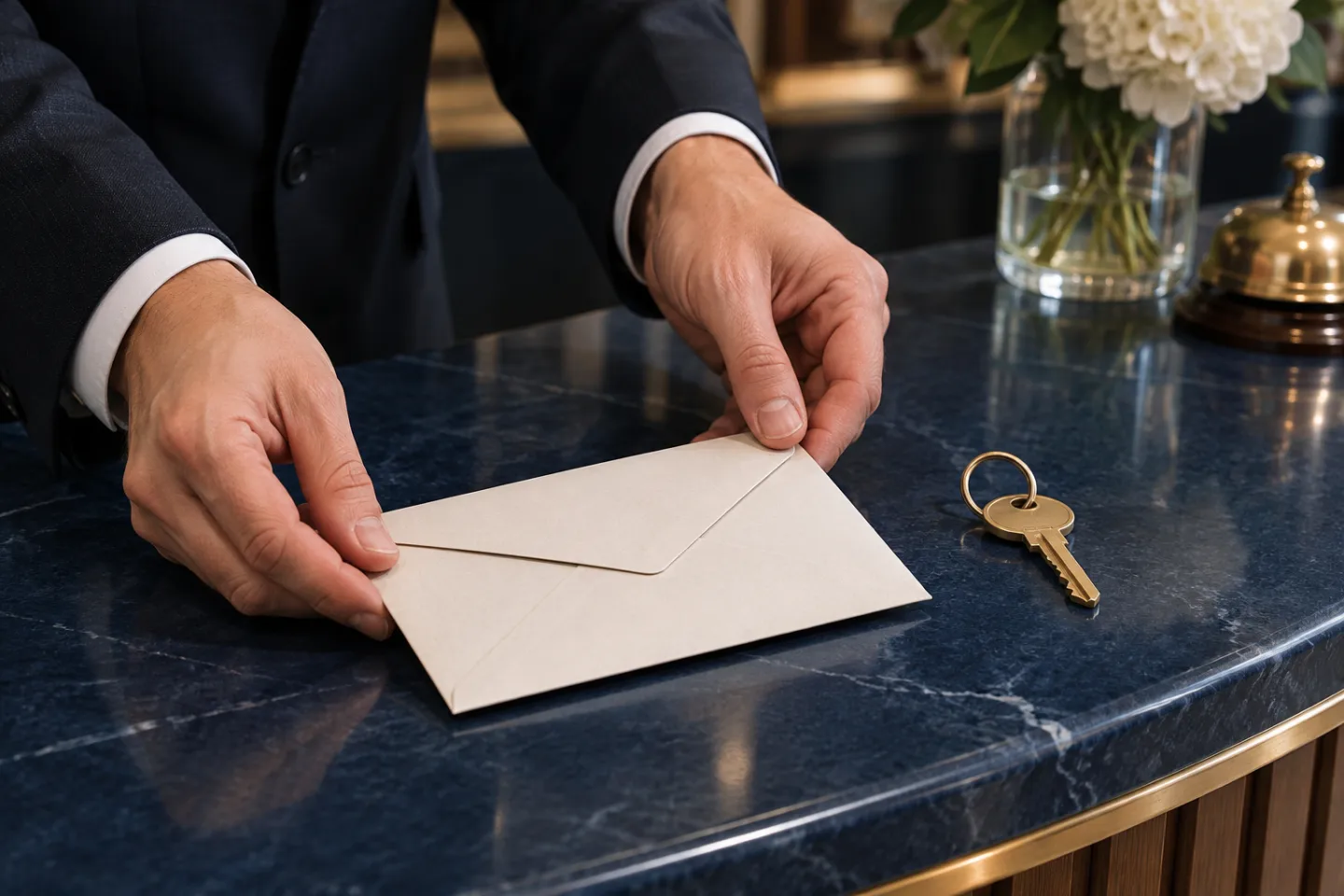
Try the same contrast with a closed envelope. 封筒を受付に置いておきます (ふうとうをうけつけにおいておきます) offers to put the envelope at reception. 封筒が受付に置いてあります (ふうとうがうけつけにおいてあります) reports that it has been placed there. If you change the location from the desk to reception, preserve the order and the particles while you say it. That way you can hear what changed and what carried over.
Report a completed preparation without mixing up the two answers
A common mistake is to treat ておく as a future tense. It can also appear in the past. 昨日、資料を机に置いておきました (きのう、しりょうをつくえにおいておきました) says that you put the materials on the desk yesterday in preparation. It tells your colleague what you did. The result sentence instead makes the current location the point. Both can work after the task is done. Your choice depends on whether the other person is asking about the action you took or about what they can find now.
Think about what happens if a second person moves the papers. Your report of what you did yesterday can still be true. A current report that the papers are on that desk would need updating. This is a useful test for translations that make the two replies sound nearly identical. Ask which part of the situation would have to change before you would retract the sentence.
Write two prompts before you try again. One asks what you did to get ready yesterday. The other asks where the papers are now. Keep the same actor in mind. If you give the same answer twice, explain what the listener still needs to know. A short answer about the action may be enough in one case. The person looking for the stack may need a location and an indication that it is ready for them.

Notice the deliberate result in the room
窓が開いています (まどがあいています) says the window is open. 窓が開けてあります (まどがあけてあります) describes the window as having been opened deliberately. The first example uses 開く (あく), which describes what happens to the window. The second uses 開ける (あける), which describes what someone does to it. The Tokyo University of Foreign Studies module on てある explains how an intentional action leaves the object in a resulting state. It does not follow that a report using 開いています denies that somebody opened the window.
Look around a room and choose one detail you can report without knowing its history. If you see an open window but have no idea why it is open, the plain state description is enough. If the organiser says it was opened for ventilation and a visitor asks about the room setup, the intentional result is relevant. In the practice pair, focus on the question you are answering. Avoid guessing a reason that the sentence or context has not supplied.
Use the Japanese grammar overview if you need to review verb pairs before extending the drill. At first, stick with an action that can leave an observable arrangement. Papers remain on a desk and a window remains open. A sentence about an action that leaves no obvious result is less useful for learning this particular contrast.
Practise the part that slows you down in KanaWay
Open a short grammar session in KanaWay for Android. Pick a familiar verb in a te-form explanation or exercise. Pause before you reveal the answer and say the form aloud. Check the feedback, then repeat the verb as part of a full phrase. If the verb changes differently than you expected, spend a moment on that change before adding an ending. Your aim is to keep the first part stable while you think about the situation.
Keep the workshop scene on paper alongside the app. After the in-app exercise, use the verb 置く or 開ける to make a plan and a report. Say both aloud and write down the one you hesitated over. If you picked the wrong ending, note what question you were trying to answer. If the ending was right but the verb sounded wrong, return to the verb drill instead of repeating the whole paragraph.
On the next review, try the same pair with the cards reversed. Begin with the finished room and then imagine agreeing to set it up. The change in order matters because otherwise you may learn to say the plan first simply by habit. Check that you can choose the correct perspective with no example visible.
Listen for the ending before deciding what to do
Say 資料を机に置いておきます and 資料が机に置いてあります at an even pace. Ask a partner to read the two in a different order, or record them for later. On the first listen, decide whether the reply promises an action or reports the current setup. On the second, check the particle and the ending. The Japanese listening practice guide offers ways to use a short recording without turning every replay into a transcription exercise.
A more practical test is to give the listener two objects, an envelope and a pencil, and let them respond to what they hear. If the report says the envelope is already at reception, they should point to a place or say where to collect it. If the speaker says they will put it there, the listener can acknowledge the plan. Either response tells you whether the ending had the effect you meant.
When the distinction is still hard to hear, isolate おきます and あります, then put the te-form back in front of them. A form is useful when you can recognise it inside an ordinary sentence. Start with the version you can say clearly and only then ask your partner to read it at a more natural pace.
Finish with a three-line handover
Use a plan, a completed action and a current report. First, tell a colleague that you will put the materials on the desk before the workshop. Next, say that you put them there yesterday in preparation. Finally, tell a visitor where the materials are now. Keep the same papers and desk throughout. A partner should be able to tell which question each line answers without having to guess what point you meant to make.
Now swap the handouts for an envelope or use the window pair. Say the new sentences without opening your notes. When you check your answers, listen for one distinction at a time. Did the base verb name the right action? Did the ending fit the speaker’s reason for saying it? Could a listener tell what to do next? These questions give you a specific place to return to when you review.
Try the same exercise with a real preparation you can describe honestly. Before an event, offer to do one task. Afterward, report what is ready for the next person. The successful reply gives them a useful answer, whether that is permission to wait for you or enough information to walk over and find what they need.