Te shimau in Japanese draws attention to an action reaching an endpoint or to a result the speaker has to deal with. A friend says they will finish a book by tonight. At a station, someone realizes they left their ticket at home. Both can use しまう after a verb in the te-form. The grammar alone does not tell you to congratulate someone or help them find a replacement ticket. The situation supplies that information.
Read the short scenes below with a pencil and two columns on a sheet of paper. In one column, write what happened or what someone plans to do. In the other, write what the outcome means for the people in the scene. You can work through all the examples without audio or an app. If possible, then trade one of your answers with another learner and see whether you inferred the same next step.
Hear the outcome in te shimau in Japanese
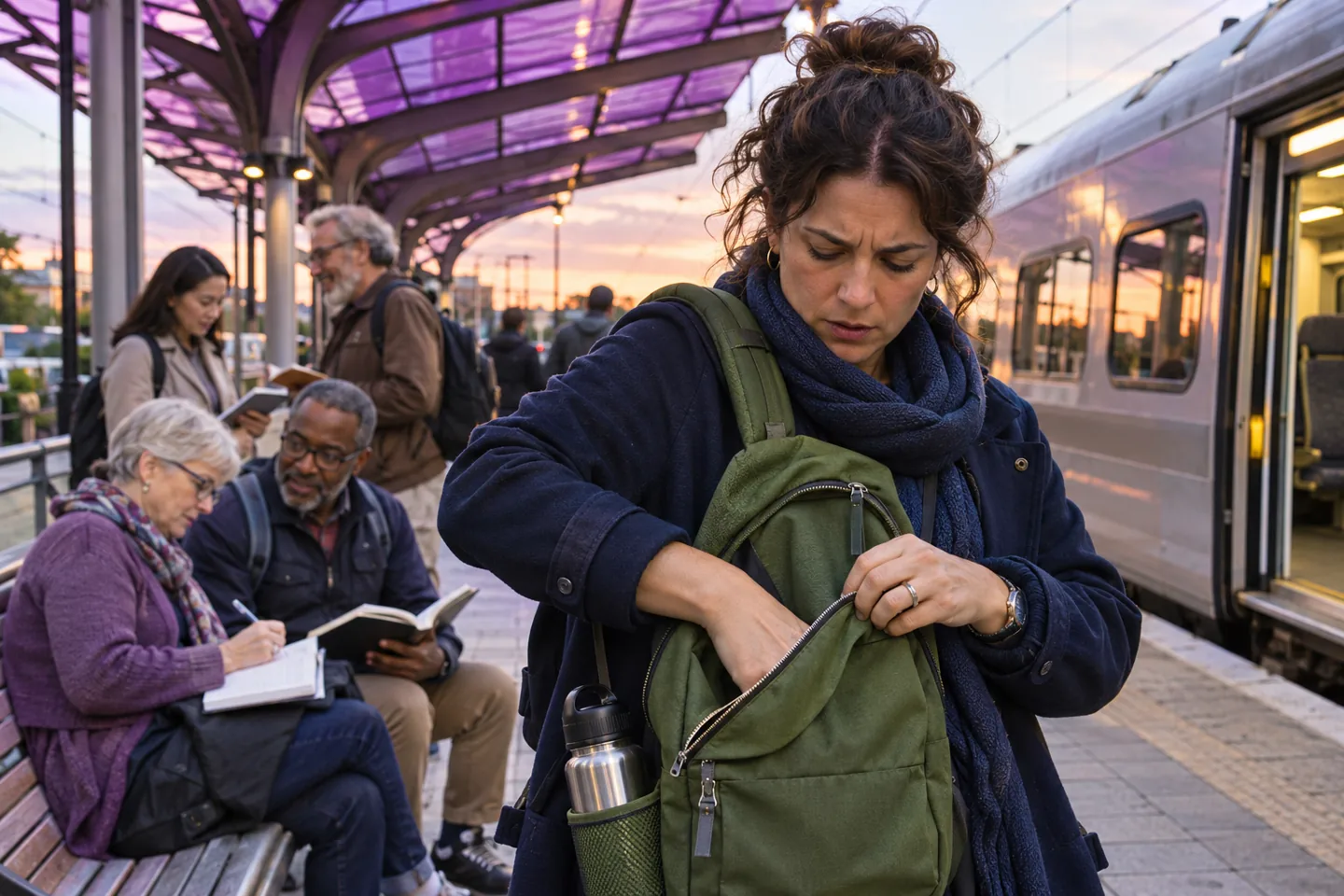
Imagine that you and a friend are about to go through a ticket gate. Your friend stops, searches their coat and says 切符を忘れてしまいました (きっぷをわすれてしまいました), “I forgot my ticket.” The Japanese ending presents the forgetting as an outcome that matters now. The scene tells you why it is unwelcome. An English translation can leave out “unfortunately” because the situation already conveys the problem. The main fact to recover is the missing ticket. A helpful follow-up would be to ask where the ticket was left.
Now imagine a library book that is due tomorrow. Someone has one chapter left and says この本は今日中に読んでしまいます (このほんはきょうじゅうによんでしまいます), “I’ll finish this book by the end of today.” Here the completion is still ahead and is part of the plan. The speaker has no need to express regret. Ask yourself what will count as done: there should be no part of the book left to read. That endpoint lets the listener understand why the book can be returned the next day.
Put the two statements side by side. First underline the main action, then identify the practical consequence: deal with the missing ticket or prepare to return the book. If your translation gives the same emotional tone to both people, look again at the consequences. A context-based reading gives you something concrete to check instead of requiring you to guess a speaker’s feelings from a suffix.

Build the form from an action you know
Begin with 忘れる (わすれる, to forget) and change it to 忘れて (わすれて). Add しまう to make 忘れてしまう. Start a second line with 読む (よむ, to read). Its te-form is 読んで (よんで), giving 読んでしまう. The construction accommodates both て and で endings. If you are unsure about a verb’s form, check the earlier step first. The Japanese grammar overview can help you revisit the te-form before you work on the nuances of the complete expression.
To place the action in the past, change the last verb: 忘れてしまった (わすれてしまった). In a polite statement you can use 忘れてしまいました. The action part stays in the te-form even though the event is past. Mark the boundary where the two pieces meet. If you inadvertently make both pieces past, rewrite the line with the boundary marked and try again with 読んでしまった (よんでしまった).
There is also an independent verb しまう meaning “put away.” In 本をしまう (ほんをしまう), the book is put away. In 本を読んでしまう, the reading is the action under discussion. This distinction is useful when you look up the form in a Japanese dictionary: a literal translation of the independent verb will not explain the reading example. Copy a short phrase along with the dictionary entry so you can tell later which use you saw.
Describe something you intend to finish
Suppose your friend asks whether you can lend them the book. You want time to read the last chapter first. 今日中に読んでしまいます sets a boundary on a plan. If the other person knows which book you mean, the statement can work without repeating the title. The polite ending suits a polite exchange. An informal statement to a close friend could use 今日中に読んでしまう. The main action and the deadline remain the same.
For a finished version, use 全部読んでしまった (ぜんぶよんでしまった), “I finished reading it all.” Place this on a card with a description of what comes next. You might be ready to return the book. You might also be disappointed because you wanted to save chapters for a trip. The reading is complete in either case. The reaction depends on the speaker’s plans and the conversation.
Try replacing the book with a meal, starting from 食べる (たべる, to eat) and 食べて (たべて). In an agreed scene where someone is finishing the food on their plate before leaving, 食べてしまう can describe getting that task done. Give your listener enough information to see the goal. Avoid treating the form as a rule that requires an explicit word such as 全部 in every sentence. A shared plan can make the endpoint clear.

Explain an unwelcome result and decide what comes next
Return to the station. The speaker can simply say 切符を忘れました (きっぷをわすれました) to report that they forgot the ticket. In the fuller statement with しまいました, the outcome is especially salient. The train has not left yet, so the situation may still be fixable. The grammar does not certify that the problem is irreversible. Concentrate on the fact that the speaker has realized what happened and understands that it affects the immediate plan.
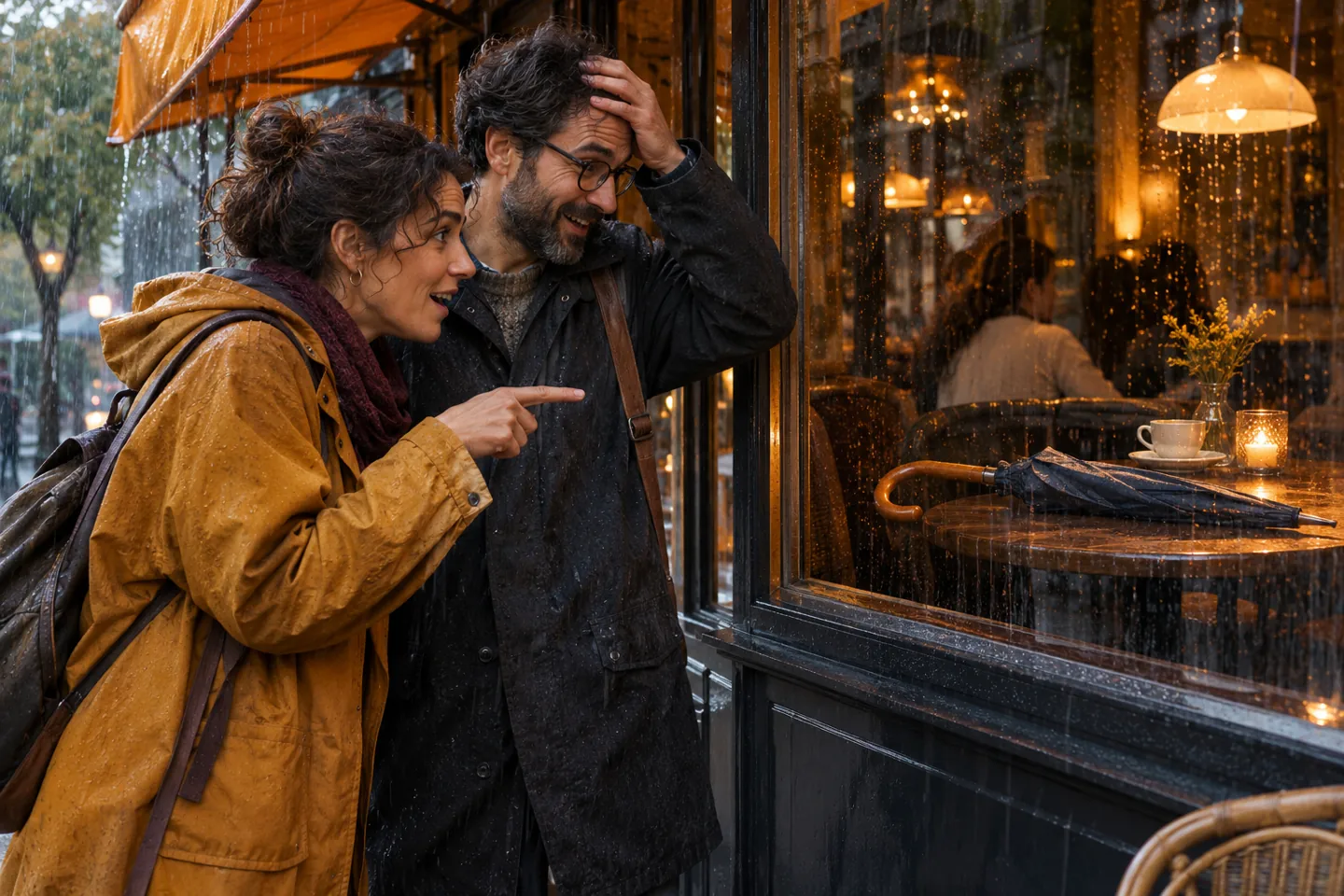
Build two more cards. On the first, draw a person arriving at a cafe without the umbrella they planned to bring. Use 傘を忘れてしまった (かさをわすれてしまった), “I forgot my umbrella.” On the second, show the same person remembering it and bringing it. Ask a partner to select the matching card. Then ask what the person might do because of that result. The statement itself does not tell us whether they will borrow an umbrella or wait for the rain to stop.
This check also helps you avoid treating every unwelcome result as an accidental physical action. Someone can choose to do something and later regret the result. Ask whether the scene gives evidence about the original intention, the present reaction, or both. If you can only see the present reaction, keep the interpretation modest. A translation such as “I ended up…” can work in some contexts, while a simple past with the right surrounding sentence is often more natural.
Recognize the shortened forms in conversation
In casual speech, 忘れてしまった can become 忘れちゃった (わすれちゃった). 読んでしまった can become 読んじゃった (よんじゃった). Learn the pairs together: てしまう can shorten to ちゃう, and でしまう to じゃう. The full form helps you explain what you heard. Use it as a reference rather than pronouncing the expanded form as though your friend had actually said every syllable.
Take a line from each earlier scene and rewrite it as a short exchange between friends. A person who forgot something might say 忘れちゃった. A reader who is pleased to have finished might say 全部読んじゃった. If you switch the speaker’s reaction while keeping the same words, both the surrounding scene and your delivery can change. The contraction tells you that the wording is casual. Look beyond it for the speaker’s attitude.
For listening practice, say the two pairs aloud or ask a partner to read a line while you look away. Write the main verb and the full form before making a translation. If you hear じゃった but forget which verb preceded it, replay the whole phrase rather than drilling the last syllables alone. The Japanese listening guide offers a way to focus on short segments. You can also do the exercise with your own recording and a paper solution.
Use a second sentence to settle the interpretation
Cover the explanation and read 全部読んでしまった in two settings. In the first, the person needed to finish before lending the book to a friend. In the second, the person had hoped to save the last chapter for a train ride. In both settings the book is finished. In the first, a useful next line might be “You can borrow it tomorrow.” In the second, “Now I’ll need something else for the journey” fits. These responses show different consequences without requiring different Japanese morphology.
Now change the time. A friend says 今日中に読んでしまいます and still has a chapter left. Is their reading finished already? No. This is a plan to finish by the end of the day. The time expression and final form matter. If you want to report that the friend already completed the reading, you need a past expression and a setting that supports it. A correct answer identifies both the expected endpoint and when it applies.
Check a last scene with the umbrella. Someone at the cafe says 傘を忘れちゃった as rain starts. Decide what you know before inventing the rest of the story. They forgot the umbrella, the casual ending is the shortened form, and the rain makes the outcome inconvenient. You do not know whether it was left at home, on the train, or at work. Practising that boundary between the stated event and a reasonable inference will make your translations more precise.
Retest with one change at a time
The next day, draw one fresh picture for a finished task and one for a problem caused by an outcome. Choose verbs whose te-forms you can check. Say a short Japanese line for each picture, then tell a partner when the action took place or will take place and why the outcome matters. If neither picture makes the intended meaning clear, add a second sentence that establishes the plan or the problem.
Review your two columns. If the main verb is wrong, repair its te-form. If the time or level of politeness is wrong, check the last verb. If the facts are right but the reaction is unclear, improve the surrounding scene. Give each type of error its own repair. End the session by reading your strongest pair once more and explaining what each listener could reasonably do next. That gives you a simple way to test the form again when it appears in conversation.