
Telling time in Japanese can become surprisingly difficult between seeing a clock and saying a complete answer. You recognise the digits, but hesitate over four o’clock, the ending of the minutes or whether half past four starts with four or five. Practising the whole message solves a different problem from reciting numbers in order.
This guide builds a small, usable system: identify the hour, attach the correct minutes, add the part of the day when needed and answer a real question. You need paper, a clock and a checked reference. Work with invented practice times rather than anyone’s private appointments. The aim is a clear exchange, not a speed contest or a promise that one session covers every time expression.
Telling time in Japanese starts with the question
Begin with 今、何時ですか。 The reading is いま、なんじですか, and the meaning is “What time is it now?” A suitable answer to a practice clock showing nine is 九時です。 Read it as くじです: “It’s nine o’clock.” The final です gives you a complete polite answer; you do not have to invent an activity to fill the sentence.
Distinguish a point on the clock from a length of time. 三時, さんじ, identifies three o’clock. 三時間, さんじかん, means three hours. A question about the current clock needs the former, not the latter. If your note says “three hours”, first decide whether it describes a duration or a badly labelled appointment before translating it.
Draw two columns on paper: displayed time and spoken answer. Put 9:00 in the first and 九時です in the second. Add a separate duration example below, clearly marked as such. This simple contrast makes the unit visible. For now, practise clock readings; a full lesson on how long activities last would introduce a different sentence task. Check the meaning before treating a fluent pronunciation as a correct answer.
Keep the hour and its reading together
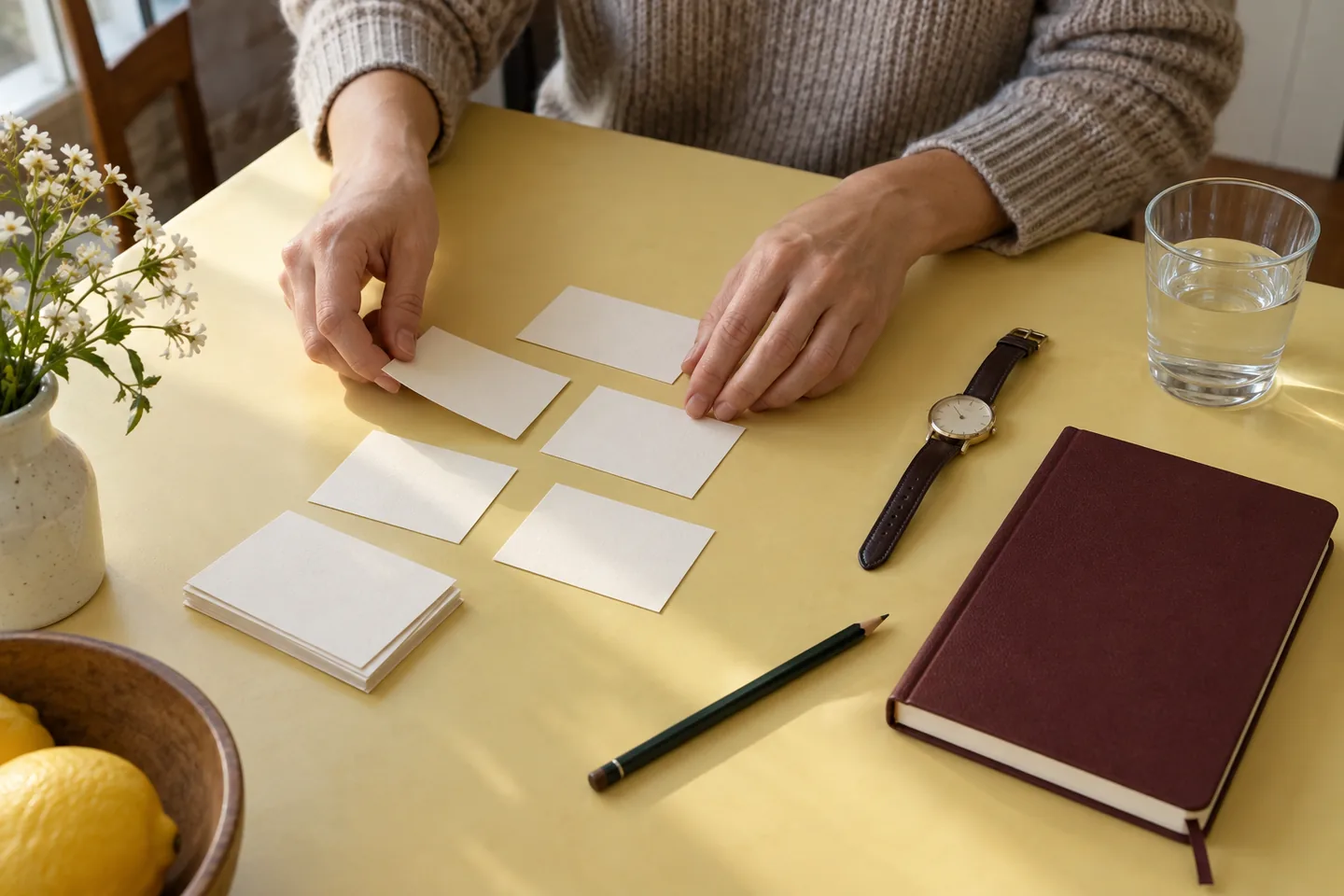
The hour uses 時, read じ here. For one through twelve, the readings are いちじ, にじ, さんじ, よじ, ごじ, ろくじ, しちじ, はちじ, くじ, じゅうじ, じゅういちじ and じゅうにじ. Four, seven and nine deserve their own cue cards: 四時 is よじ, 七時 is しちじ and 九時 is くじ in the practice models used here.
Do not generate these forms by attaching じ to whichever isolated number reading first comes to mind. Learn the complete hour as a unit. The Japan Foundation’s time chart gives hour and minute readings in separate columns and also records variants. Our consistent starting set is a practice choice, not a claim that every other attested pronunciation is impossible.
Mix 4:00, 7:00 and 9:00 with familiar hours instead of chanting the list from one each time. Look at a cue, say the hour and check its kana. If 4:00 repeatedly causes hesitation, repair よじ directly, then return it to the mixed pile. There is no need to restart all twelve entries after each mistake. A dictionary can resolve an uncertain reading, but check the full time expression rather than assuming every reading of 時 applies to a clock.
Build minutes from checked sound units
Minutes follow the hour and use 分. A useful initial set is 一分 いっぷん, 二分 にふん, 三分 さんぷん, 四分 よんぷん and 五分 ごふん. Continue with 六分 ろっぷん, 七分 ななふん, 八分 はっぷん, 九分 きゅうふん and 十分 じゅっぷん. You will also encounter じっぷん for ten; keep one checked model consistent during an initial exercise rather than treating that variant as a new meaning.
Notice two kinds of change: the ending may be ふん or ぷん, and the number itself may change, as in いっぷん or ろっぷん. Saying an ordinary number and then always adding ふん will not reliably produce the forms above. Mark only the entries you actually confuse, rather than colouring the entire reference sheet.
Combine the parts in order. 四時十五分 is よじじゅうごふん, 4:15; 九時八分 is くじはっぷん, 9:08. At 9:08, the hour uses く and the minutes use はっぷん. Do not read the display’s leading zero as an extra spoken number in these examples. Write the hour and minute chunks separately once, then say them together. If your number knowledge is uncertain, reduce the practice set to five, ten and fifteen minutes before adding the less familiar endings.
Use han for half past the named hour
半, はん, after an hour means half past that hour. 四時半 is よじはん, 4:30. 四時三十分, よじさんじゅっぷん, names the same clock time through the minute count. These are alternative ways to express thirty minutes past four; you do not attach both endings to the same hour.
The Japan Foundation’s Marugoto lesson explicitly pairs the minute form and 半 form. Use that connection as a meaning check: convert 4:30 to 四時半 and back to 4:30. If your first language describes the half hour by looking forward to the next hour, do the numerical check before speaking. The Japanese expression names the hour already reached.
Practise three close cues: 4:00, 4:15 and 4:30. Keep よじ stable while changing only the ending. Then mix the same endings with seven or nine. Avoid adding “half” simply because the long hand is somewhere between two numbers; it specifically represents :30 in this construction. A clear numerical cue is more useful than an ambiguous decorative clock image. You can draw the times yourself and keep the written answer folded underneath. Unfold it after attempting the answer, not while searching for the first syllable.
State the part of the day when it matters
A bare four o’clock may be clear in a shared situation, but it does not distinguish morning from afternoon. 午前, ごぜん, marks a.m.; 午後, ごご, marks p.m. Place it before the clock time. 午前九時 is ごぜんくじ, 9 a.m. 午後四時十五分 is ごごよじじゅうごふん, 4:15 p.m. Keep that qualifier when removing it could change the practical message.
Practise with both a numeric display and a short situation label. A card marked 16:15 can be matched to 4:15 p.m. and then to 午後四時十五分. That is a conversion task, so check the numbers before judging the Japanese. If you choose to practise a twenty-four-hour reading, verify its full form separately; this guide’s core spoken models use twelve hours with a clear qualifier.
Do not guess at noon or midnight from a poorly labelled “12”. Ask for clarification in a real scheduling exchange and use an unambiguous written time when necessary. Likewise, a correct clock reading does not settle the date, location or time zone of a remote meeting. Those details require their own confirmation. Our exercise deliberately isolates the hour and minutes so you can see which part you know, without pretending that a number alone resolves an entire appointment.
Listen, write the digits and diagnose the mismatch
Use a short, checked recording from a learning resource or ask a partner to read a reference-backed time. Listen once without seeing the transcript and write the digits you understood. Then reveal the model and compare hour, minutes and part of the day separately. The question is not simply whether the entire line was right or wrong.
Suppose the model is 4:15 p.m. but your note says 4:50 p.m. The hour and qualifier survived; the minute sequence needs attention. Compare the actual recording with the written fifteen-minute form before repeating it. If you wrote 9:08 instead of 4:08, work on the hour contrast. Do not repair a listening error by repeatedly copying a sentence you have already understood visually.
For spoken practice, record your own attempted answer if your device offers local recording, then compare it with the checked model. An unfamiliar voice or a faster delivery may make the task harder, so start with a clear short utterance. Keep the audio source available for replay instead of claiming that one transcript check proves you will recognise every speaker. After a targeted repair, return to the original cue and write the digits again. That final step checks whether the correction reaches the message you wanted to understand.
Ask, answer and confirm the same information
A compact practice exchange can be 今、何時ですか。 followed by 午後四時十五分です。 The readings are いま、なんじですか and ごごよじじゅうごふんです. The exchange means “What time is it now?” and “It’s 4:15 p.m.” Use it beside an invented clock rather than presenting it as the actual current time.
Switch roles with a partner. One person holds a numerical cue; the other asks the question without seeing the answer. The listener writes what was said, and both compare it with the card. A successful exchange preserves the same hour, minutes and qualifier across three representations: cue, speech and written response. Correct grammar with the wrong minute is still the wrong message.
If you did not understand, もう一度お願いします, もういちどおねがいします, politely asks for repetition: “Once more, please.” A repeated answer is useful only if you then check the unclear piece. Do not nod through a number you are guessing. For this exercise, showing the card after a second attempt is a sensible check. In an actual appointment, also confirm whether the speaker means a start time, arrival time or another point in the schedule; a current-time question does not automatically ask any of those things.

Finish with a small mixed retrieval test
Prepare six cues: 4:00, 7:00, 9:00, 4:15, 4:30 and 9:08. Say each in a complete answer, then compare it with your checked reference. The key forms are よじです, しちじです, くじです, よじじゅうごふんです, よじはんです and くじはっぷんです. Keep the digit cues visible and the answer side hidden until your attempt is finished.
On a second pass, add “a.m.” or “p.m.” to selected cards and retain the qualifier in the answer. On another day, shuffle the same cards and try without rereading the list first. Record whether the difficulty was the hour, the minute ending, the half-hour meaning or the qualifier. A small useful error note is more actionable than a total score with no explanation.
You do not need a new tool to complete this routine. A paper reference, a simple clock and a patient partner are sufficient; a solo learner can alternate reading and hidden-answer production. Add unfamiliar minutes only after checking their forms. Stop when you can explain the remaining uncertainty and choose the next cue to repair. The practical goal is modest and concrete: hear or see a time, say the intended time accurately and notice when further confirmation is needed.